Lābh Panchami
Today is Lābh Panchami, a festival observed on the fifth day of the Kartik month, according to the Hindu calendar1. The first day of Kartik month is observed as the new year in Gujarat, a state/county located in western part of India.
According to the custom, the majority of businesses close on Diwali, the last day of the previous year, and opens on Lābh Pāncham, the fifth day of the new year. The businesses reopen from today and gradually get back to their regular schedules.
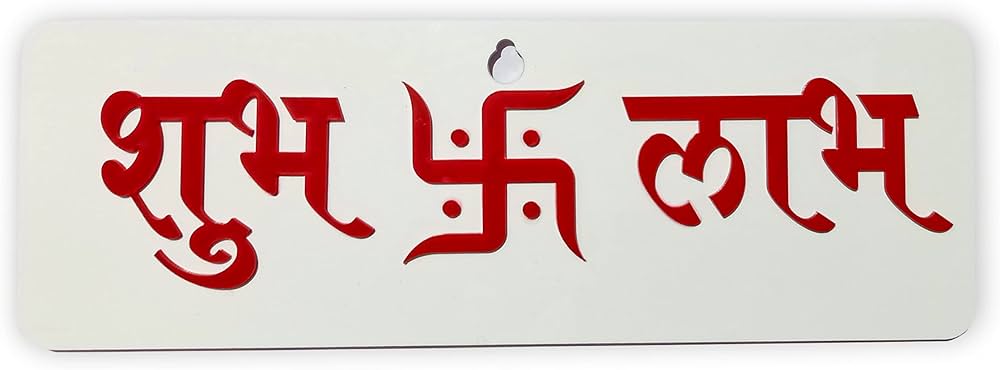
On this day, the phrases “Shubh” and “Lābh” with the Swastika in between are painted using kumkum, a red coloured sacred powder, on the doorsteps of homes and businesses, to bring good luck.
Rationale
This raises the question on the reasons, and the rationale behind this tradition.
The most important thing to do is to begin the new year with prayers and an expression of appreciation for everything that you have been given over the last year. The second is to offer up prayers that the upcoming year may be fruitful in every manner. Prosperity extends beyond material possessions, it also includes receiving blessings and enjoying good health, happiness, and mental peace.
However, all of the above could have been wished by writing only one word, “Lābh”, which means “receiving benefit or profit” and the occasion is also celebrated as “Lābh” Pancham. Then the next question arises on why is the word “Shubh” required, and what is the reason for it to be written even before “Labh”?
The closest English word to “Shubh” is “auspicious,” or “goodness,” as there is no like-for-like word in English language. It is written before “Lābh” to instill in the culture the idea that gaining something or getting money is meaningless if it did not come from moral sources. This could also be read to suggest that if you are virtuous, money or profit will follow.
It is fascinating to notice that organisations have also prioritised this ancient tradition in past decade or so. Nowadays, the majority of businesses support one or more social causes in one way or another. Large-scale transformations also aim to alter organisational culture, ways of working, and methods of operation by shifting priorities, such as purpose above profit. They say that focussing on profit does not help in driving the colleagues, whereas focussing on purpose motivates the employees within the organisations.

Also, customers are interested in high-quality items, but they are more likely to purchase from businesses and organisations that support social causes. A further illustration of this is the modern social media “cancel movement“, which works completely opposite. In this case, if a business is perceived to promote an incorrect cause, both current and potential customers may try to cut back on their purchases, to affect the business negatively.
The United Nations has defined the 17 Sustainable Development Goals (SDG) to help individuals and organisation to align themselves, and orient them into a direction where more help is required.

There are non-profit organisations that certify organisations on how well they are aligned to these social causes, e.g. B Corp.

Where we want to be is up to us. Should we focus on individual performances, generate “pounds per petabyte“, or should we align ourselves to the goal of creating a larger society? No, it was never someone else’s problem and it will come to our shore! Rather than just ourselves, should we not be living up to the insight of “Vasudeva Kutumbakam” from the Vedic times, meaning “The World is One Family”.
We have the option to bring in a “New Me” on this auspicious day, one that is dedicated to achieving a larger goal rather than just personal or organisational gain. Let us put “Shubh” before “Lābh”, the choice is ours.
Happy Diwali, Happy New Year, Happy “Shubh Lābh Panchami“!

References:
- The Hindu Calendar: The standard calendar is based on the sun, whereas the Hindu calendar is based on the lunar cycle. A lunar cycle consists of 29.5 days on average. In comparison to the solar calendar, the Hindu calendar, which has 12 months, is 11 days short [365 days – (12 months * 29.5 days) = 11 days]. As a result, an extra month is added every three years, known as Adhika Mās, to reintegrate with the solar cycle. A similar concept is found in the solar calendar as well. Since there are 365.25 days in a solar cycle but only 365 days in a year, a day is added every four years (leap year) to return back and rejoin the solar cycle. The lunar months in the Hindu calendar are further split into two cycles. This is to represent the waxing and waning of the sun. Krishna Paksha: Full Moon to New Moon; Shukla Paksha: New Moon to Full Moon. The Gujarati calendar starts with Kartik month as the first month of the calendar, some other calendars starts with Chaitra month as the first month of the year. This calendar is widely used in Northern and Western India. The calendar began in 57-56 BCE. ↩︎
- Taken from QAspire.com ↩︎
- UN SDGs: https://sdgs.un.org/goals ↩︎
- B Corp/B Lab Movement: https://www.bcorporation.net/en-us/movement/about-b-lab/ ↩︎
Bhavin Shukla has been working as an IT Consultant in the data space for more than 25 Years. As a Data and Analytics professional, he has worked extensively for years on complex IT Transformation Programmes within Healthcare, Finance, Insurance and Telco domains.
Bhavin is driven by a sincere desire to embrace a spiritual existence rooted in values, while genuinely striving to enhance societal culture by fostering a supportive community where we stand by each other.


 Bhavin Shukla
Leave a comment