Father and Daughter Conversation Series – Understanding Enterprise Architecture
Enterprise Architecture
It was a usual morning as we made our way to school. My Nirvana moment arrived unexpectedly. My younger daughter Krishnakeli asked about what I actually do in IT. Better late than never! ⏳
Q – Daughter (Krishnakeli 🤔): What exactly do you do in IT, dad?
A: Dad (Bhavin 🤗): I work as an Enterprise Architect in IT.
Q – Daughter (Krishnakeli 👸): Hmm, I know you are a manager, and you have a lot of people working for you, isn’t it?
A – Dad (Bhavin 🙃): Not actually, I work with other people who are similar to me, but no one reports to me.
I could tell she was disappointed by the look on her face. “I thought you were a big shot 👑 in your company , and many people work for you”, a typical princess type of thought would have emerged.
We were stranded in traffic on our way to school in Leicester’s Great Glen, an outskirt area of the city, close to the newly constructed Davidson Homes. 🏘️
Q – Daughter (Krishnakeli 😟): So, Dad, you make websites, right?
A – Dad (Bhavin 🤕): Not really. Let me explain you on what I do.
Can you see these Davidson Homes? I asked. However, it must be made sure that the essential services — drinking water, electricity, gas, fuel stations, schools, stores, emergency services, etc are made available or accessible before any residential homes are built here, right?
Q – Daughter (Krishnakeli 🧐): Yes, that is true. If not, the residents will not be able to live in these homes for a longer time.
A – Dad (Bhavin 🧑🏫): Exactly. Before allowing the Davidson Homes kind of projects, the city/town planners put in the foundation work, sometimes referred to as “Capabilities“. Without them, houses could be constructed, but such an arrangement would not be sustainable or allow for the development of a community.
I perform a similar kind of work in the IT departments of the organisations. When new IT projects come in, I see to it that they have access to all the foundational resources they require for a successful completion. In order to meet future IT needs, the Enterprise Architecture in IT must determine the essential capabilities and commission it at the appropriate moment.
Q – Daughter (Krishnakeli 🥰): I get it, that will be super cool. So it means that you need to look forward and plan ahead. Before a town or city is founded, it may require a number of things. You said, “at the appropriate moment”, what does it mean?
A – Dad (Bhavin 🤗): Indeed. Every job is fascinating, and I love what I do. It is the responsibility of the Enterprise Architect to predict changes over the next three to five years and to begin planning now to accommodate any new requirements that may arise in future.
By appropriate moment, I meant that not every capability must be there on day one. These capabilities can be developed gradually. For instance, a town should have a fire department, but until the town/city reaches a certain size, there is no need for the fire department to have advanced equipment to support skyscrapers and highrise buildings. It’s also crucial to remember that even in cases when these tools are not needed, the infrastructure e.g. roads should be constructed with the possibility that there will be a need to transport such large equipments in the future.
Q – Daughter (Krishnakeli 🙄): Thank you. So if you are the town planners, then who builds houses in IT that are similar to the Davidson Homes?
A – Dad (Bhavin 🧑🏫): Great question! The houses are analogous to IT applications. The people who build these applications are called “Solution Architects“, I once used to work in this role.
Their work is fascinating too. Do you see that the houses in Davidson Homes follow a pattern?
Each of the semi-detached looks same, the 3 bedroom houses are similar, and so on. Almost everywhere in the country has a similar appearance to a Davidson Home. Similarly, the job of Solution Architects in IT is to identify and create patterns, so that builders don’t have to constantly consider how a new house, an IT application, should be built. They design these patterns to ensure that the work is repeatable, efficient, uniform, and finished on schedule.
Q – Daughter (Krishnakeli 😊): That is amazing. I think, I kind of get this. So do you have people who are equivalent to “interior designers”?
Q – Daughter (Dad 🧑🏫): Yes, we have them too! We refer to them as “Solution Designers“. Their responsibility is to make sure that the intricate and detailed level of design is captured for every pattern established for IT.
The role of the “IT Engineers” ⚒️ is to build the design laid down by the architects and designers. The actual surveryor type of work, after it is built, is done by the “IT Testing” team ✅. And the ongoing maintenance related work done after people move in to the houses is done by the “IT Support” team 🧑🔧. I have worked in all of these roles, so when I work at the town planning level, it makes it easier for me to understand and appreciate their future demands.
Does that make sense?
Daughter (Krishnakeli 🥰): Yes, it does. I now understand what you do. These houses might require a lot of builders, but not a lot of city planners.
I understand how important is the role of city planners, without it, the city would continue to grow out of control and it may not be habitable 💡. Even in cases when people have access to essential utilities like gas, electricity, and water, if the infrastructure, e.g. roads and schools, is not fit for purpose then it could lead to traffic problems in future.
I get it, thank you.
Q – Daughter (Dad 🥰): Great conversation, thank you!
To continue on that final note on fit-for-purpose infrastructure, next time, I’ll tell you about some of the world’s abandoned and ghost cities, about the cities that currently have infrastructural challenges, and how these stories are relevant to the IT world. Also, even in town planning or within Enterprise Architecture, people have diverse skills, which we will discuss.
We reached school, and my princess now seemed happy, just a bit. Phew! 😇
I and my daughters talk about the spiritual aspects and other ideas, which have been captured in other blogs, here – Father-Daughter Conversations: A Journey into Spirituality, please feel free to visit. It appears that the quest to understand IT has just begun!
Specifically in the Data and AI 🧠 space, we will cover a variety of architectures, patterns, governance, assurance, etc. The idea is to explain these in layman’s terms using analogies for both forthcoming IT prospects/apprentices, and non-technical friends and colleagues who are interested in knowing/learning how all this functions at the organisational level.
If you have enjoyed reading the write-up ✍️, please “like” 👍 and leave your feedback in the “Leave a Reply” 📋 section (scroll down to the bottom of this page); I would love to know if these are useful and how can I make it better. If you find this place interesting then please do not forget to “subscribe”🤝. Any recommendations on future topics that you want me to cover then please let me know. I may not know about it but I am an ardent reader 📚, and have a knowledgeable network of friends/colleagues, so I can definitely try and find the answer for you.
| Topic# | Topic | Description | Date |
|---|---|---|---|
| 1 | Enterprise Architecture (This) | The role of Enterprise Architecture (EA) in an organisation | 02/12/2023 |
| 2 | Architectural Pillars | Different parts of EA | TBC |
| 3 | Data Ecosystem | Describing components of Data Ecosystem | TBC |
| 4 | Data Architecture | Difference between Data Architecture, Data Governance and Data Management | TBC |
| 5 | Data Analytics Evolution | The story of Data Analytics | TBC |
| 6 | Domain-Driven Design | What is Domain-Driven Design and how is it useful? | TBC |
| 7 | Data vs Information | Data, Information and Knowledge. Information architecture concepts. Business Information Model (BIM) | TBC |
| 8 | Reference Architecture | What is Reference Architecture, and how to build one for Data and Analytics | TBC |
| 9 | Interoperability | What is Interoperability and why is it required? | TBC |
| 10 | Architecture Assurance | How to govern and assure architecture for the data ecosystem | TBC |
| 11 | Data as an Asset | How to measure the value of data? Insights from Douglas Laney’s book on Infonomics. | TBC |
The above write-ups are the author’s personal opinions.
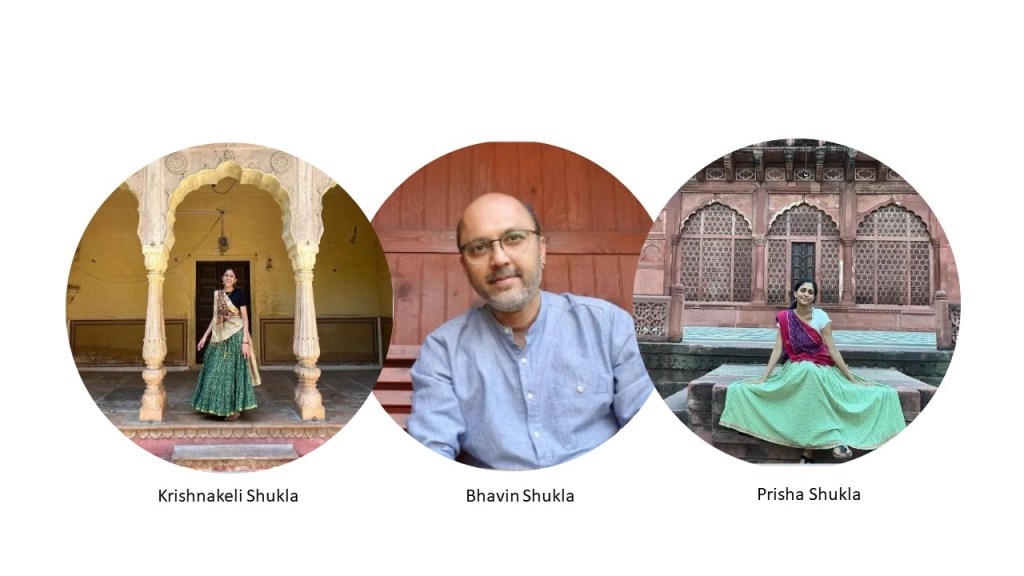
Bhavin Shukla has been working as an IT Consultant in the data space for more than 25 Years. As a Data and Analytics professional, he has worked extensively for years on complex IT Transformation Programmes, setting up Data Ecosystems, within Health, Finance, Retail, Insurance and Telco domains. Contact the author at shuklabhavin@yahoo.com, on LinkedIn, or through Twitter if you have any questions.
Prisha Shukla co-authored these write-ups and is currently studying her 4th Year of Medicine at Aston University, Birmingham.
Krishnakeli Shukla co-authored these write-ups and is currently studying in A-Levels.
 Bhavin Shukla
Leave a comment