
Rāma, the king of Ayodhyā and the lord of the Raghu dynasty, was at the southern tip of India with his army. The army sought to cross the ocean and free Sitā ji, Rāma’s consort, from Rāwana, the demon king based in Lankā, present day Sri Lanka. The only method to cross the ocean was to construct a setu, or bridge, which is today known as Rām Setu. The challenge was determining how to construct a bridge connecting India and Sri Lanka.
Introduction
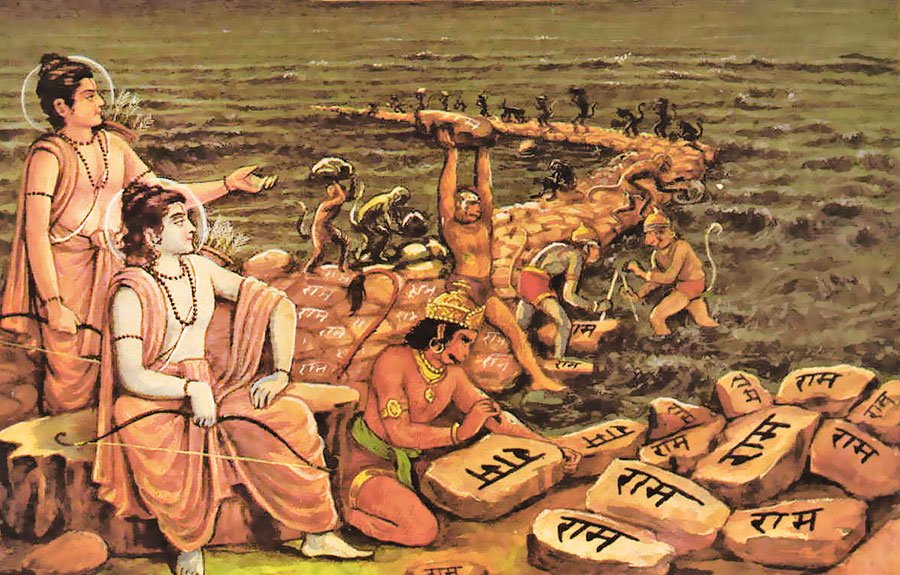
This is one of the most popular and widely known event from the epic Rāmāyan. The event was picturised in one of the TV serials, Rāmāyan by Rāmānand Sāgar1. In the serial it was shown that the rocks were floated in the ocean after writing “Rāma” on it. The word “Rāma” gave the power to the rocks to float. The architects of this bridge, and the responsibility of building this bridge was with two monkeys, named Nila and Nala.
Most people remember this scene the way it was depicted, where two rocks were joined together by writing “Ra” on one and “ma” on another, because of which they managed to stick together helping the army to build the bridge. The army then walked across the bridge to cross the ocean.
Interpretation and Misinterpretation
As stated in Rāmacharitāmānas, Rāma gets angry on Samudra, the ocean, and warns it to evaporate with its might if he isn’t allowed to cross. On hearing this, Samudra says to Rāma that there are two monkeys named Nil and Nal in his army, who were blessed in their childhood to float anything on water, even mountains. Ask them to build the build the bridge, and I will try and help as well.
Shri Premānand ji maharaj from Vrindāvan clarifies this in the video clip below.
नाथ नील नल कपि द्वौ भाई। लरिकाई रिषि आसिष पाई।।
तिन्ह के परस किएँ गिरि भारे। तरिहहिं जलधि प्रताप तुम्हारे।। [5.59.1]
nātha nīla nala kapi dvau bhāī. larikāī riṣi āsiṣa pāī.
tinha kē parasa kiēom giri bhārē. tarihahiṃ jaladhi pratāpa tumhārē.2
Rāmcharitamānas says – based on the instructions received from Samudra, the ocean, the two monkey brothers, Nila and Nala, were given the responsibility to build the bridge. Other monkeys and bears brought the rocks and trees from places, which were touched by the two brothers because of which the rocks floated on the ocean. It is worth noting that the rocks could float on the water due to the magical powers of Nala and Nila, and not because of the word “RāMa” written on the rocks. In fact, there is no mention in Rāmcharitamānas that the rocks started floating on the water due to “Rāma Nāma”, the name of Rāma, written on the rocks while building Rāmsetu.
Logical Reasoning
- Nothing is more important for the devotees than their lord’s name, not even the lord. The monkeys would not have stepped on rocks with Rāma’s name written on them. The importance of the name of the lord is described in another write-up, here: Tulsidas Ji Explains the Significance of Name.
- Tulsidās ji has not mentioned about the event that describes “Rā” and “Ma”, joining the rocks.
- As there are two such similar events in Rāmayan, which might have confused people in remembering it accurately. In addition to the event discussed earlier, there is another such event in Rāmāyana where Hanuman ji scratched/wrote Rāma nāma (name) on a rock with his nails. The rock floated on water when he put it in water. Lord Rāma after seeing this, threw a rock in water, but it submerged down to the bottom. On asking, Hanuman ji said, the one who is left by Rāma cannot come up and will always be submerged. This event in gujarati is referred as, “Rāma nāme patthar tare” or in hindi as “Rāma ke nāmse pathhar tairte hai”. They both are related to rocks floating on water, which could have caused confusion.
Is Rāmāyana a Mythology?
The story of Rāma is so perfectly characterised that it is impossible to believe it to be true. Years of oppression and aggression could have led to the alteration of real history, and converted it to a mythology. One of the tactics / strategies employed by the aggressors in the past has been to purposefully create an environment in which people forget its great history and believe it was all a myth. This may cause individuals to lose their identity, preparing them to adopt another culture.
Recent works by the archeology has found traces of Rāmasetu, which can be seen from the satellite imagery. Then ISRO cheif Somnath said, “We can view Ram Setu, also known as Adams Bridge via satellite images, but whether it is man-made or natural, for that you will need experts from domains such as the Archaeological Survey of India and other such departments”.3

Conclusion
Myth or history, is a matter of faith and belief. Irrespective of it, it is everyone’s duty to remember the event correctly and read the reference books wherever possible, here Rāmcharitamānas. This is to ensure that whatever version is preserved is not further distorted because of our ignorance.
There are two main parts of the above article:
- Rām Setu: It is a bridge established between the good (the Lord) and the bad (the Demons), implying that there is always a door open for conversation.
- The importance of name: It is impossible that the monkeys in the army would have walked on top of the name of Rāma. The idea expressed here is also pertinent in modern times. Nowadays, people wear t-shirts, tops, and other items with lords’ names engraved on them. These clothing are then laundered in locations that may accidentally bring disrespect to the Lord’s name. This begs the question, are the new traditions attributable to the erosion and dilution of the value of the Lord’s name? And are they linked to the reasons of we remembering the history and stories incorrectly?
What are your thoughts about Rām Setu? Is it a myth or reality? What do you think of people wearing clothes with the Lord’s name on them, do you think this will cause disrespect to the lord’s name? Even with references provided from Rāmcharitamanas and as clarified by Premānand ji maharaj in the video clip, do you still believe that the rocks floated because of Rāma word written on it, and that is how Rāmsetu was built? Please let me know in the “Leave a Reply” part, I would love to know your thoughts.
Please, Share, Like and Subscribe
If you have enjoyed reading the write-up ✍️, please “like” 👍 and leave your feedback in the “Leave a Reply” 📋 section (scroll down to the bottom of this page); I would love to know if these are useful and how can I make it better. If you find this place interesting then please do not forget to “subscribe”🤝. Any recommendations on future topics that you want me to cover then please let me know. I may not know about it but I am an ardent reader 📚, and have a knowledgeable network of friends/colleagues, so I can definitely try and find the answer for you.
About the Author
Bhavin Shukla has been working as an IT Consultant in the data space for more than 25 Years. As a Data and Analytics professional, he has worked extensively for years on complex IT Transformation Programmes within Healthcare, Finance, Insurance and Telco domains.
Bhavin is driven by a sincere desire to embrace a spiritual existence rooted in values, while genuinely striving to enhance societal culture by fostering a supportive community where we stand by each other.
Reference
- Rām Setu, Rāmāyan serial by Rāmānand Sagar: https://youtu.be/1N8b3KBZFGk?si=kumE-mGThrvVyqqt ↩︎
- Online Rāmcharitamānas, Sundarkānd: https://www.ramcharitmanas.iitk.ac.in/ramcharitmanas?tid=6&tid_1=11&tid_2=8 ↩︎
- ISRO to ink new deal to identify Ram Setu, other archeological sites: https://www.indiatoday.in/india/story/isro-to-ink-new-deal-to-identify-ram-setu-other-archeological-sites-2352230-2023-03-27 ↩︎
 Bhavin Shukla
Leave a comment