Morāri Bāpu, a prominent spiritual teacher, and my spiritual guru, discusses the significance of Ayodhyā’s Rām Mandir during his Rām kathā in Ayodhyā.
What is Rām Kathā?
A katha is a spiritual discourse in which the spiritual leader discusses numerous issues pertinent to present times and connects them to spiritual occurrences in order to assist the audience in developing various ways for overcoming life’s challenges. Rām kathā draws on Lord Rāma’s life and character as a spiritual foundation. The story of Lord Rāma is generally narrated from two key Hindu books: Rāmāyana by Mahārishi Vālmiki and Rāmcharitamānas by Goswāmi Tulsidās ji.
Morāri Bapu and Ayodhyā Rām Mandir
Morāri bāpu aka Bāpu, has been reciting Rām kathā for almost 6 decades. His method of providing spiritual discourse is unique and resonates strongly with the youth. Bāpu chooses a subject or theme for the nine-day spiritual discourse/talk.
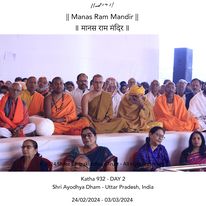
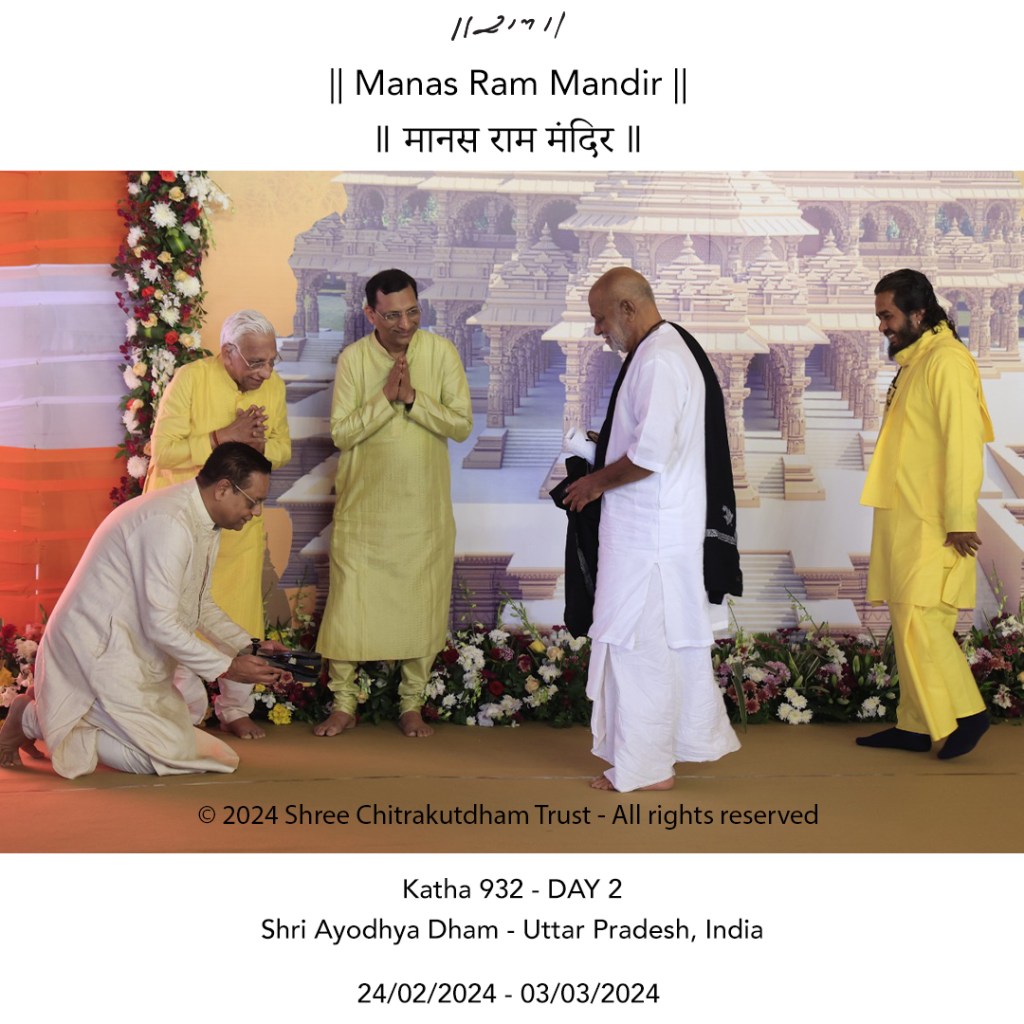
The theme of the current Rām kathā, which is being held at Ayodhyā from 24th February 2024 to 3rd March 2024, is Mānas Rām Mandir, where he is engaging in a discussion with the audience about Ayodhyā’s newly built Rām Mandir (temple).
Bāpu is among the largest contributors to the construction of the Rām Mandir.
Excerpts from Mānas Rām Mandir Rām Kathā

Bapu said in his katha, the phrase/mantra “Jai Shree Ram” was used to unite the people who were in favour of building the temple. We should greet each other with the slightly altered mantra “Jai Siya Ram,” where Siya is equivalent to Mātā Sitā, since the temple has now been constructed. This will facilitate the process of reconciliation between the opposing groups.
Furthermore, the name of the female deity is usually recited before the name of the male deity in Sanātan dharma, so Jai Siya Ram is more appropriate. In addition, Jai Siya Ram contains six syllables, whereas Jai Shree Ram has only five, making it a superior shadākshar mantra.
In his kathā, Bapu classified three categories of katha,
- vichār pradhan / विचार प्रधान (based on intelligence): the conversation that aims to debate metaphysical topics or introduces novel ideas
- uchhār pradhān / उच्चार प्रधान (based on pronunciation): a conversation that is focused on reading and presenting spiritual texts in the right way, with correct proounciation.
- āchār pradhān / आचार प्रधान (based on principles): a discourse that attempts to change people’s behavior and implement social reforms at grassroots levels that affect how people connect with one another
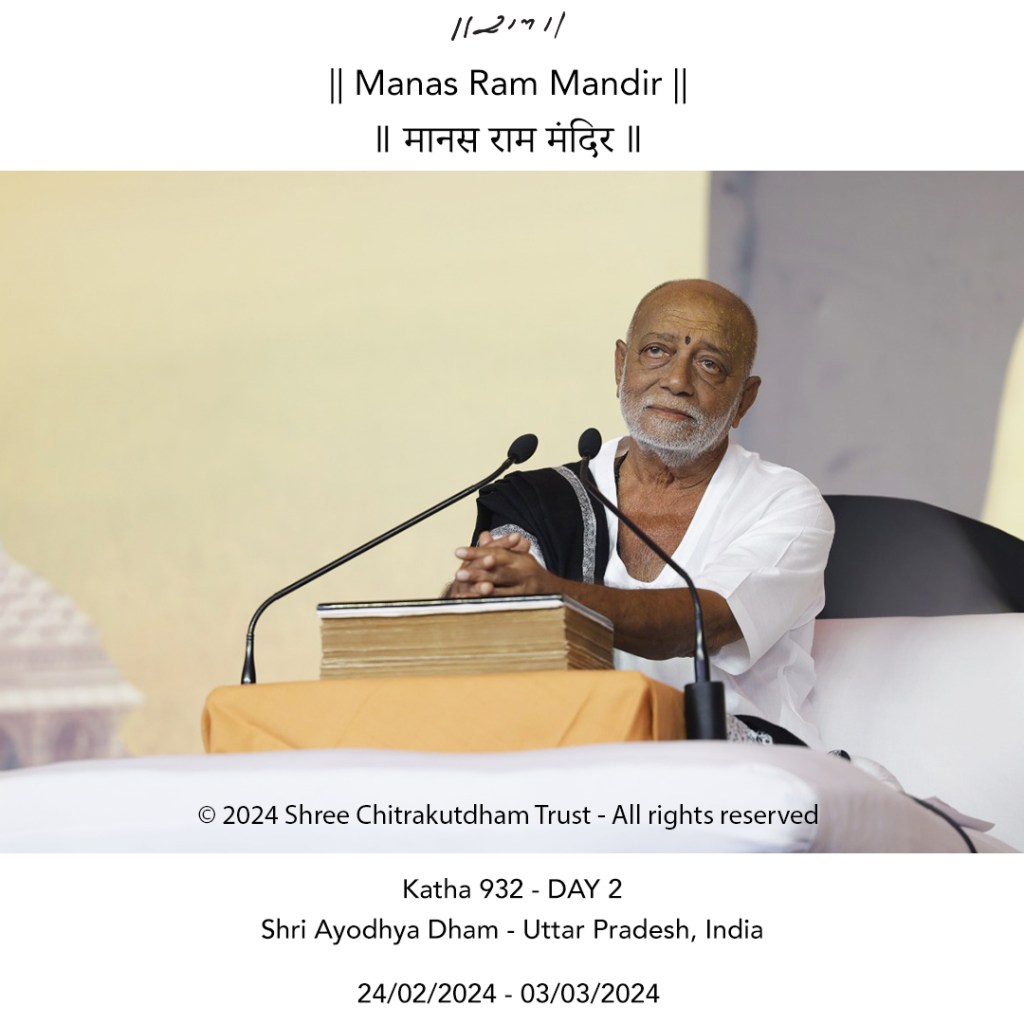
Bapu’s kathas fall under the category of “āchār pradhān”.
Thus, he urged the audience to consistently listen to the Kathā, as it aids in enhancing our āchār (behavior) through the study of Rām’s character through the Rāmcharitamanas granth (book).
Bāpu explained the significance of the Ayodhyā temple by stating that it is exceptional and unique due to its three features. The Ayodhyā mandir is:
- Bhavya / भव्य (Grand): Although the word “bhavya” implies “grand,” its true meaning is “sārvajanik,” or “universal,” meaning that it must be for everyone. It is evident that people are drawn to the temple from all around the world.
- Divya / दिव्य (Divine): Being divine really means that one is continually having a fresh experience. After the opening, there has been a noticeable change in the deity of Lord Rama’s facial expression in the mandir. The sculptor of the Rām lalla deity, Arun Yogiraj, has also confirmed this in one of the interviews 1.
- Sevya / सेव्य (Served): Sevya means that the temple is built specifically to fulfill the deity’s needs. There may be numerous additional purposes for which the temples are built.
According to Bapu, the Ayodhya temple is vishisht (unique and outstanding), sarvajanik (public), and vaishvik (universal) i.e. it has all the three characteristics, bhavya, divya and sevya which makes the temple unique.
Ram lalla’s mandir in Ayodhya is a Vishishtha (special) mandir.
There are four different kinds of mandirs, according to Bāpu, and each one has to be attended to. They are as follows: 1) Our body (देह मंदिर – Deh Mandir) needs to be properly taken care of and serviced; 2) Our Heart (दिल मंदिर – Dil Mandir) needs to be in good health; 3) The deity to whom we pray (देव मंदिर – Dev Mandir) wants our service; and 4) Our Country (देश मंदिर – Desh Mandir) also needs our assistance. Ram Mandir is a dev mandir; the other three need to be given the same priority.
Bapu outlines the reasons behind the exceptional and unique nature of Lord Rama. We must take lessons from the life of Lord Rama. The reason his character shines is that he surrounded himself with five different kinds of individuals.
- वयोवृद्ध – Vayo Vridh: individuals at a particular stage of development, such as Vishwamitra
- विवेक वृद्ध- Viveka Vridh: individuals with a certain degree of intelligence and the ability to discriminate between right and wrong
- तपोवृद्ध – Tapo Vridh: disciplined hardworks pursuing their objectives with diligence
- सर्जन वृद्ध – Sarjan Vridh: refers to the creaters, such as authors, poets, artists, etc.
- भजन वृद्ध – Bhajan Vridh: the sincere followers
Bāpu goes on to say that keeping company with good individuals is not enough; we also need to stay away from bad company. He cited the cases of Manthra in Rāmayan and Karna in the Mahābhārata, both of whom committed some of the worst errors. In the Mahābhārata, it was Karna who publicly humiliated Draupadi, resulting in the epic fight. In the Ramāyan, it was Manthrā who caused Kaikeyi to send Lord Rāma to fourteen years of exile.
Then, how can one identify bad company (कुसंग – kusang)? Bapu says that there are four ways that bad times arrive.
- काल – kāl or Time: There could be nothing one can do about it, for example, an earthquake can bring poor luck.
- कर्म – karma or actions: the narrow-mindedness that results in a state of resentment, gossip, or other negative emotions [राग, द्वेष, ईर्षा, निंदा, शोषण – (संक्रामककक सोच)] causes this kind of sorrow
- स्वभाव – sometimes a person’s nature forces them to dwell in sorrow
- गुण – guNa: this kind of grief is caused by the imbalance of the three gunas, satvik, tāmsik, and rajas [गुण माने रस्सी, बांधे रखना].
Our karma or the deeds of others can assist us in identifying the bad company. A person’s tendency for gossip, jealousy, and/or continual thoughts of retaliation can be signs of a terrible company.
Kathā Chopai – Mānas Rām Mandir
Apart from the core theme of Rām kathā, Bapu selects one chopai (verse) from about 11,000 verses in Rāmcharitamānas to serve as the primary kathā chopai pertinent to the subject matter. The one below was the katha chopai chosen for Mānas Rām Mandir katha.
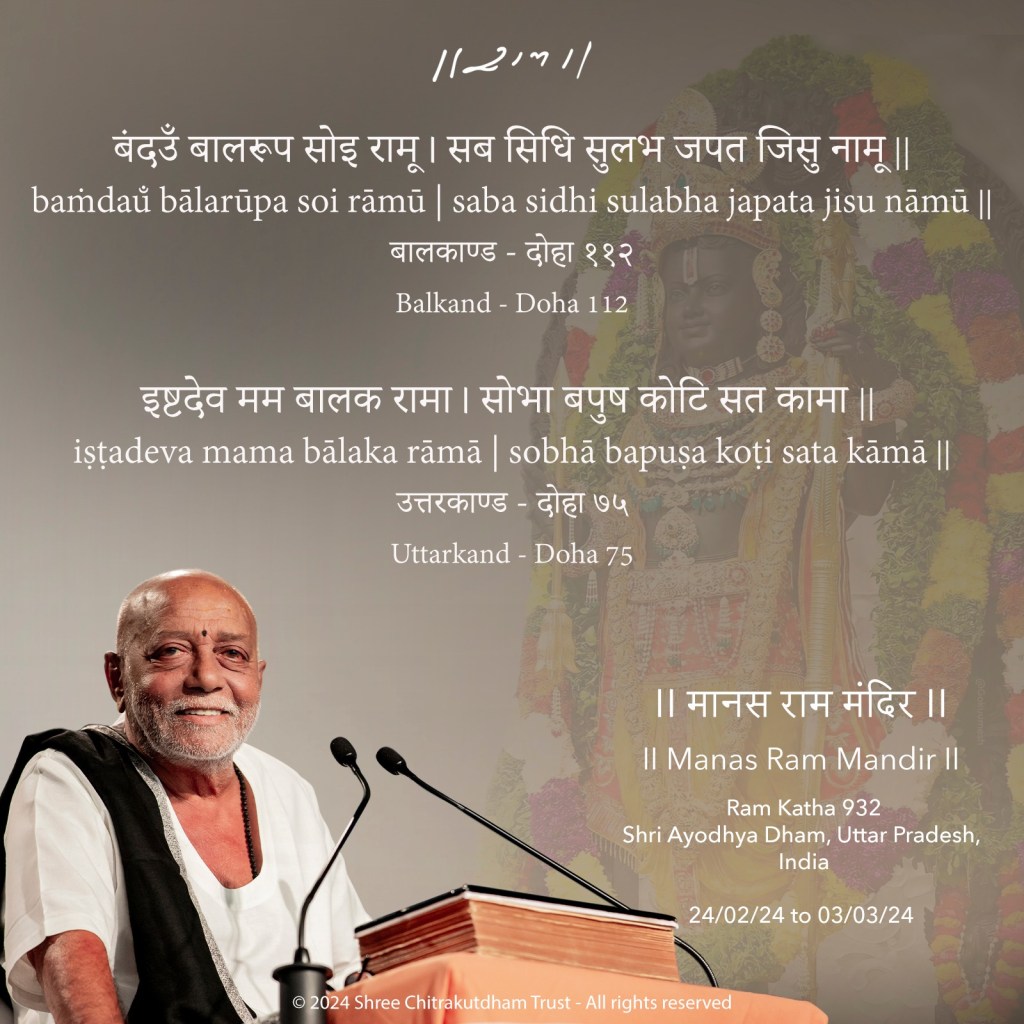
The first stanza’s meaning is: Him do I reverence in the form of a Child, the repetition of whose Name brings all kinds of success without our easy reach.
The second stanza’s meaning is: The child Rāma is my beloved deity, who sums up in His person the charm of countless cupids. This stanza is spoken by Kākabhusundi to Garuda maharaj.
Bapu goes on to mention that there are eight different kinds of sidhhi, or accomplishments or talents. Having siddhi is beneficial, but it is insufficient if it isn’t purified (shudhhi). As mentioned in the above verse, chanting the name of Rāma yields accomplishments that have been purified and ensures that they will be put to the proper use, for the benefit of the society.
Kākbhusundi ji imparts his knowledge in the chopai’s second section. Because nobody else is as intelligent as Kākbhusundi, it is important to pay close attention to what he has to say. According to Bāpu, there are instances when a devotee’s lord becomes so connected with them that He tries to emulate them. Rām lalla deity has adopted Kākbhusundi ji’s (crow) black shade, otherwise lord Rām is blue in colour.
You can view the YouTube video where my daughters, Prisha and Krishnakeli, attempt to sing the verse and illustrate how to sing it.
Going forwards: the Role of Ram Mandir and Morāri Bāpu
It has been traumatic for more than 500 years, and the temple’s history reveals that many lives have been lost. It is encouraging to see that the Indian government and the supreme court have stepped in to find a workable solution that would satisfy all sides.
As said by Morāri Bāpu, now that the mandir has been established, it is appropriate to put the unpleasant memories behind us and make amends with everyone. Since the mandir is sarvajanik and vaishvik, it should belong to everyone and is not affiliated with any particular party or community. As the ultimate truth, or Sākshāt Brahm tatva, Lord Rama does not belong to any nation, religion, or social group. Given the number of ongoing conflicts in different parts of the world, the stage is set for the Rām Mandir to use the principle of “Vasudev Kutumbakam” —which states that all people are members of one family—to unite people worldwide.
I pray that the opening of the temple will lead to reforms throughout the world and that the child form of Rām bhagwān draws in all people without any biases and contributes to world peace.
Talking about Lord Rama as the one who can help bridge (setu) the gap between individuals and communities, Bapu believes in dialogue and has mentioned extensively in a number of kathas.
Bāpu discussed the Sanātan dharma practice of parikrama, which is the circumambulation of a diety in a clockwise direction. Even if Rām bhagwān is the ultimate truth, we nevertheless practice parikrama in order to view the truth from all angles. This is the lesson we should apply to our lives—rather than becoming one-dimensional, we must embrace different points of view.
To guide the world toward the correct path, view different perspectives and to reconcile various groups, we need more Rām kathās and spiritual leaders with the qualities of Pujya Morāri Bāpu. Bapu’s main message of this katha was, “બધું છોડજો પણ કથા સાંભળવા નું નહિ છોડતા – badhu chhodjo pan kathā sāmbhalvānu nahi chhodtā”, i.e., it is okay to let go of everything but never ever stop listening to the Ram kathā, as that is the one that will bring about social and cultural reforms in our lives and in the society.
Jai Siyaram 🙏
References
- Arun Yogiraj interview: https://www.youtube.com/watch?v=I9Y4UviIioQ ↩︎
Please, Comment, Share, Like and Subscribe
Bhavin Shukla has been working as an IT Consultant in the data space for more than 25 Years. As a Data and Analytics professional, he has worked extensively for years on complex IT Transformation Programmes within Healthcare, Finance, Insurance and Telco domains.
Bhavin is driven by a sincere desire to embrace a spiritual existence rooted in values, while genuinely striving to enhance societal culture by fostering a supportive community where we stand by each other.
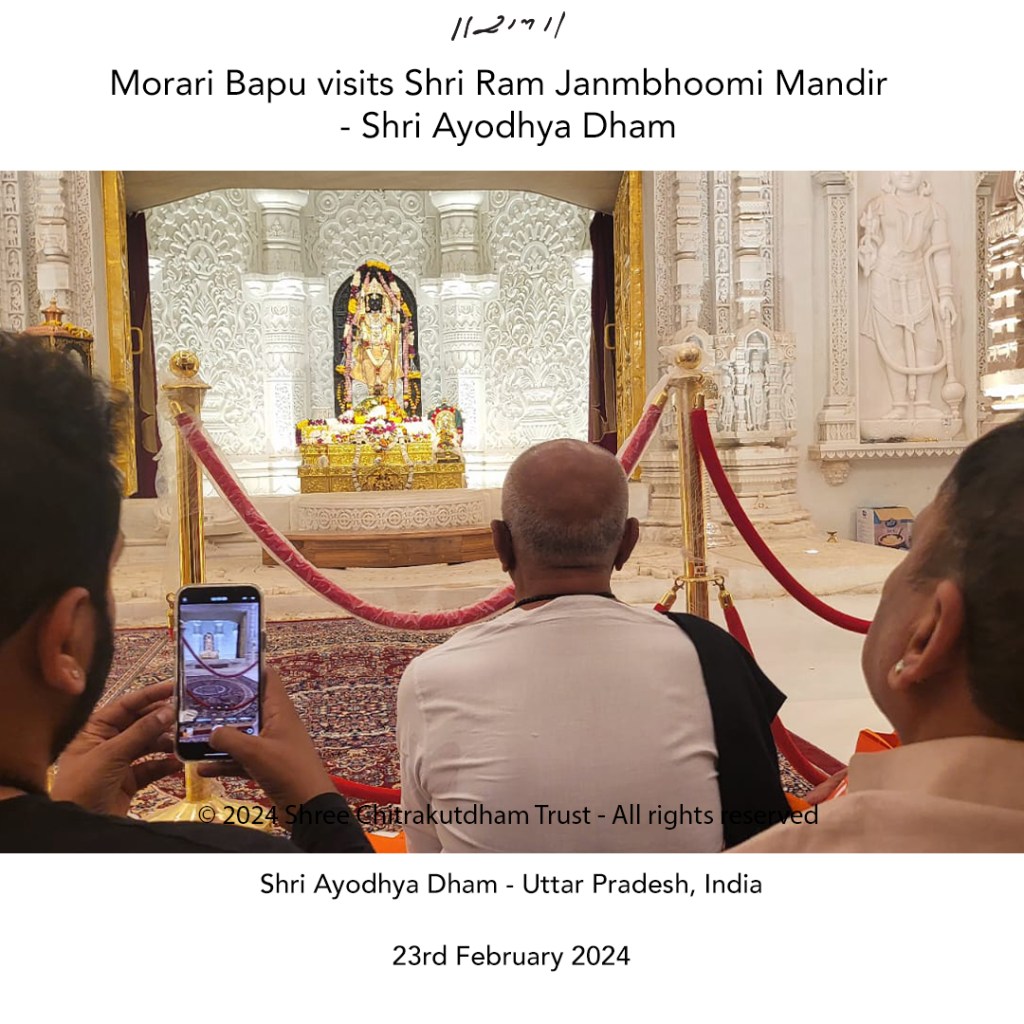
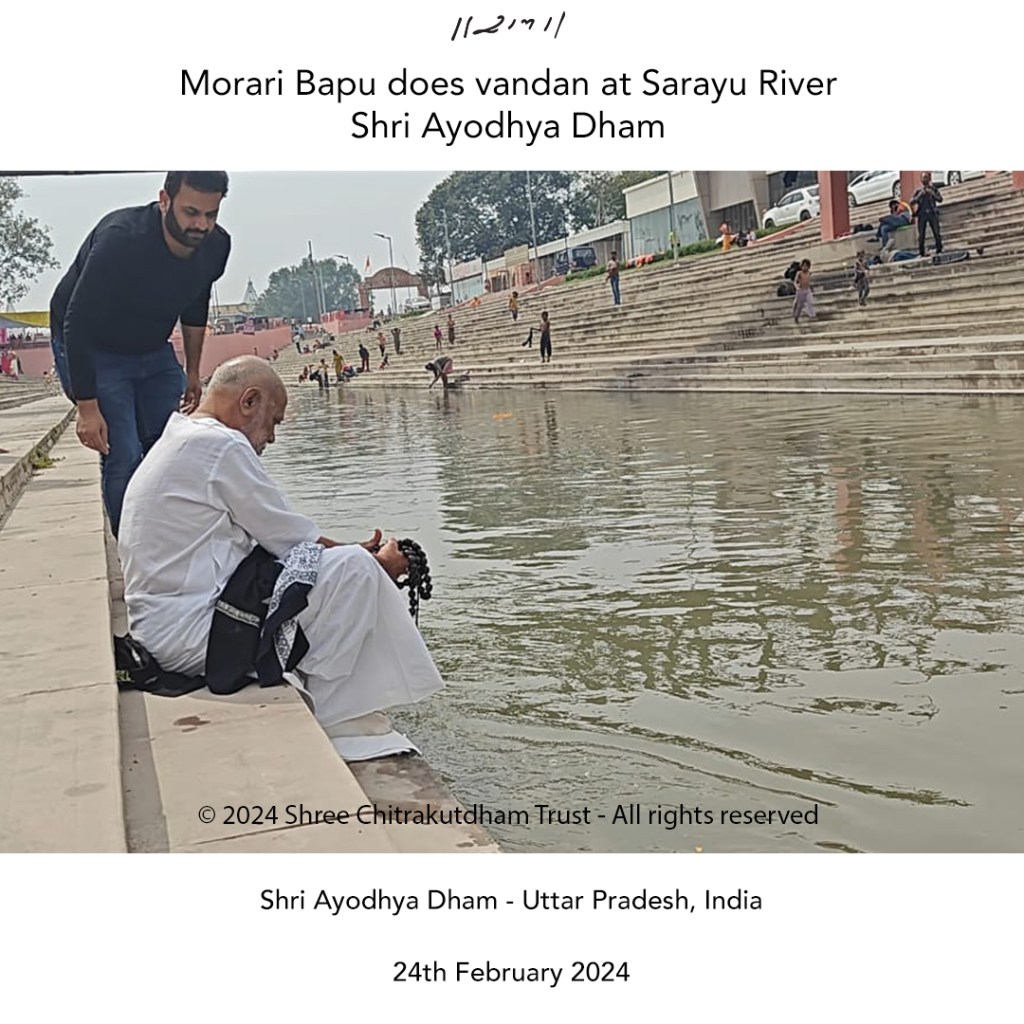
Photo Gallery : Mānas Rām Mandir







 Bhavin Shukla
Leave a comment