Putting ideas into action involves four steps. Imagine (kalpanā), Decide (sankalp), Deliver (kārya), and Accomplish (siddhi). The third stage, kārya, is the Ground Zero, which is the “happening place” and where the majority of the “action” occurs.

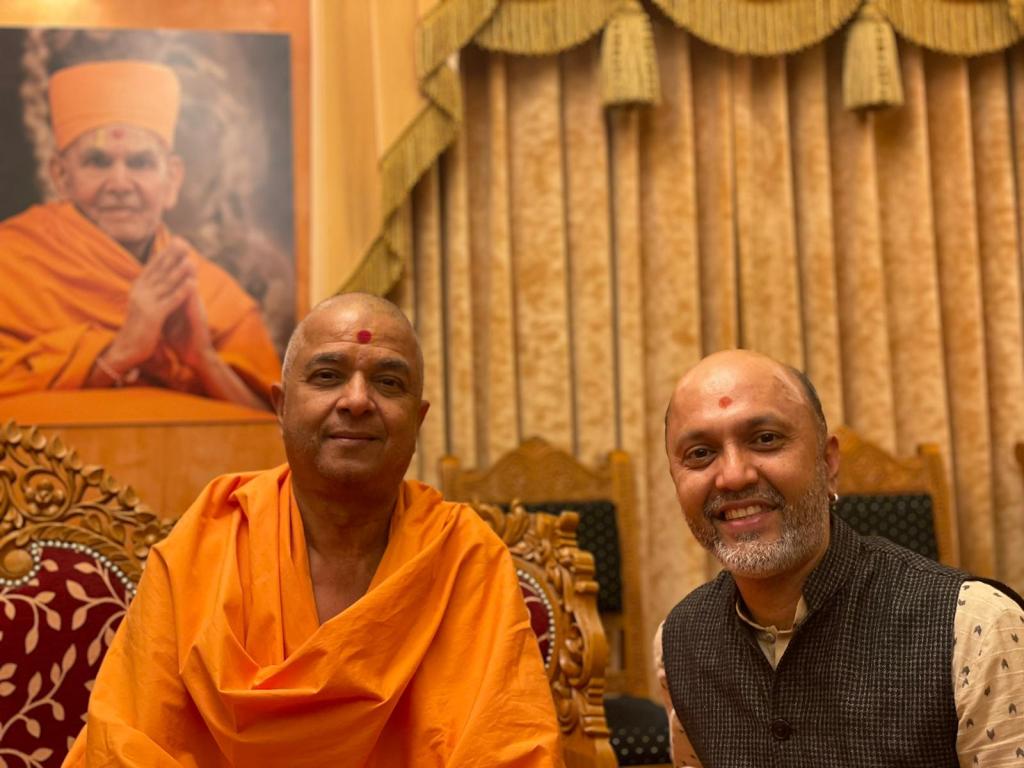
Pujya Brahmvihāri Swāmi is the force behind the newly constructed historic Hindu temple at Abu Dhabi. I was fortunate to experience and meet BAPS’s Ground Zero, Pujya Brahmvihāri Swāmi.
The following narrative reflects my understanding and subjective interpretation of the informal conversation. Pujya Brahmvihāri Swāmi would have articulated things more thoroughly, but unfortunately, my constrained understanding allowed me to only grasp a small portion of it 🙏.
Please “like” 👍 and provide feedback in the “Leave a Reply” 📋 area (scroll down to the bottom of this page) if you enjoy reading the article ✍️. I would love to know if these are helpful and how I can improve it. If you find this blog site interesting then please remember to “subscribe” 🤝.
Param Pujya Pramukh Swāmi Mahārāj and The Regret

Transcendence, an excellent book written by APJ Kalam on his interactions with his spiritual master, Param Pujya Pramukh Swāmi Mahārāj, is where I first learned about Pujya Brahmvihāri Swāmi.
On multiple occasions in this work, Pujya Brahmvihāri Swāmi is quoted as having been present at the pivotal moments when the two legends met.
As a student of science who completed his master’s degree in physics at the esteemed Indian Institute of Technology in Mumbai, I greatly admire and love my idol, APJ Kalām. I will always regret not having had the opportunity to meet my idol’s spiritual guru, Param Pujya Pramukh Swāmi Mahārāj, also known as Bāpā by BAPS satsangis (devotees), in person because I was unaware of His life’s work and what He accomplished for humanity.
In the same way that a deer having the most beautiful eyes, or vision, is perpetually on the lookout for something in the forest, as Surdās ji said in his poetry collection Karman Ki Gati Nyāri, I am also continually on the lookout for the kind of experience I would have had with Pujya Bāpā had I met him in person.
With Pujya Brahmvihāri Swāmi in London, the sādhu who spent a lot of time with Pujya Bāpā, I had to take up the opportunity to meet him in person and experience Pujya Bāpā firsthand.
Pujya Brahmvihāri Swāmi : A Brief Introduction
Pujya Brahmavihāri Swāmi (Sādhu Brahmavihāridās) is a sādhu initiated by HH Pramukh Swami Maharaj, who handles International relations for the BAPS Swaminarayan Sanstha, a socio-spiritual volunteer Hindu organisation. Pujya Swāmi has contributed to the design, concept, and construction of several BAPS temples, including Delhi Akshardhām, Gandhinagar Akshardhām, London Neasden Mandir, and Robinsville temple in New Jersey. He recently oversaw the historic project of constructing the first traditional Hindu Mandir in the Middle East, in Abu Dhabi.
The BAPS’s Ground-Zero is Pujya Brahmvihāri Swāmi. He is that reliable engine of delivery that continuously and consistently turns sankalp into siddhi. Furthermore, he is a modest giant who is so appreciative of his gurus that he dedicates all of his accomplishments and glory to Pujya Bāpa, the guru that initiated him as a sādhu, and Param Pujya Mahant Swāmi Mahārāj, the current guru of BAPS.
Conversation with Pujya Brahmvihāri Swāmi
What I loved about Pujya Brahmviharai Swāmi was that, despite having an extensive knowledge and having read the majority of the Hindu scriptures, Pujya Brahmviharai Swāmi’s answers were grounded in his life experiences rather than being theoretical, philosophical, or bookish. Instead, they were practical, acquired from living his life to the fullest.
His responses are specifically tailored to the audience’s nature and level of maturity. For instance, he said that it would not be age appropriate to discuss meditation with a child who is five or six years old, we should instead read The Winds in the Willows to them.
What is Happiness?
There is a famous quote of Pujya Bāpā, “In the Joy of others, lies our own”. I asked Pujya Brahmvihāri Swāmi about the meaning of “joy” mentioned by Pujya Bāpā. Is it the ultimate happiness, known as param-ānand? And how can I know if the joy I’m spreading to others is deserved? I could be doing good for a criminal and assisting that individual in a criminal action.
Pujya Brahmvihāri Swāmi, a thinker who thinks ten times before taking action, responded that he had also thought about this several times. And he interprets joy or happiness as “a state of selflessness”. To understand selflessness, consider the concept of “sleep,” in which a person is not fully conscious. How delighted one feels in sleep when a person’s deeds (or inactions) occur subconsciously or unknowingly.
This is the state we should aim toward. The joy is in the kārya (doing) rather than the outcome, and it is done without thinking about it, i.e. without consciousness. And when one incorporates his abilities and passions (ruchi) into those activities, the world becomes a better place than it was. As a result, our activities benefit others rather than ourselves.
This is an amazing thought. While I am aware of the teachings of the Bhagwad Gita, someone actually practising and living it, rather than merely preaching, highlighted the spiritual level of Pujya Swāmi.
The ideology also implies living in the current moment and not worrying about the past or future, which can only be accomplished by letting go of our own-self or ego.
Recognising the Defining Moment
This led me to my second question, which is how to determine whether the current moment is a “defining” moment.
Pujya Swāmi responded from Ground Zero. Very crisp, concise, and clear. He said no one would know about it. It is only when you look back and connect the dots that you will discover it.
When traveling through the Abu Dhābi desert with Swāmi in 1997, Bāpā said, “We will have a mandir here one day.” At this point, Swāmi asked Bāpā to bless the desert by placing His feet on its soil. I probed further whether Pujya Swāmi, being a visionary, was aware that this was the pivotal moment, the deciding moment, as the construction of Abu Dhabi Mandir, which will take 27 years to complete, will create history for the entire civilisation.
Pujya Swāmi stated, “I had no idea at that time.” He asked Pujya Bāpā to touch his toe to the ground, then gathered the sand and took it with him. However, his actions were motivated only by love for his guru, Pujya Bāpā.
The conversation ended there because there was no further logic required to comprehend it. Everything was said in that single statement. They were real-life events, thus there was no need for any explanation.
Conversation Summary: The Nectar
The conversation and the way it all unfolded were both fascinating to me. The two questions were answered and now connected.
If I had to sum up the entire conversation in one word, it would be “Love”.
Love is about living selflessly, being who you are meant to be, i.e. living according to your ruchi, and offering yourself to everyone, regardless of whether another person shares your mindset or not. You must be loving without thinking about who will receive your love; it is almost like blooming like a loving flower.
The dots are connected; I would not have understood the message if I had not first understood Love, as stated in one of my blog posts, What is Love.
I continued by outlining my goal of using my blog to try to spread positivism. In my blogs, I explore other faiths and sampradāya (sects) to uncover gems, inspirational stories, and valuable insights from throughout the world, which I then share with those seeking hope and optimism.
In response, Pujya Swāmi said that while sampradāya or any other religion is merely a means to achieving the divine, knowing God and the divine is necessary. He gave me encouragement and showed curiosity in what I do.
At that point, I got the chance to both offer the sādhu something as a sevā and ask him for something. You see, I have to “give and take” in order to avoid feeling guilty about myself! In his speech on the same day, Pujya Swāmi stated clearly that the greatest offense is to induce guilt in others.
I had two options in my mind, shall I ask for Pujya Swami’s blessings for me and my family, or request for the darshan of Pujya Bāpā’s charan-raj from Abu Dhabi’s sand. I chose for the former, as I could not live with more regret in my life. I would rather have the charan raj of the sādhu sitting in front of me, who lives his gurus preaching than going into the past. I practised the preaching that I just learnt i.e. live in the “now” moment, and let the universe conspire.
I will not go into details here, but Pujya Swāmi kindly accepted my offer of sevā. Until the Abu Dhabi Mandir’s construction was finished, Pujya Swāmi kept the letter from his Guru, Param Pujya Mahant Swami Maharaj, a secret for four years. Since I’m learning from the greatest, I would also keep this a secret until the sevā is delivered.
On this occassion, though, the sankalp of the sevā has been done by the master of Ground-zero, whereas I will be the Ground-zero. In my opinion, I can only recollect the incident where Pujya Swami requested Pujya Bāpā to put his charan on the dharā (land), from my perspecive the current write-up of writing about Pujya Brahmvihari ji is miniature in size but an analogy of that event, and I too will leave all the worries to the sādhu who did the sankalp for my sevā and the destiny.
Jai Swāminārāyan!
Memories To Cherish
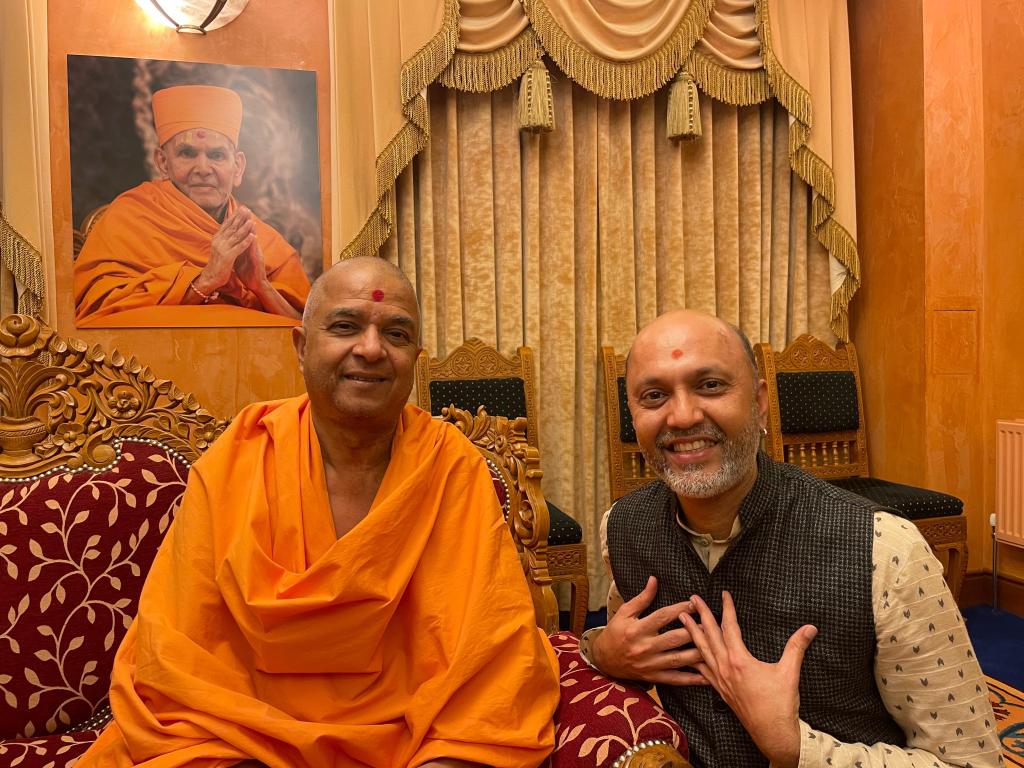

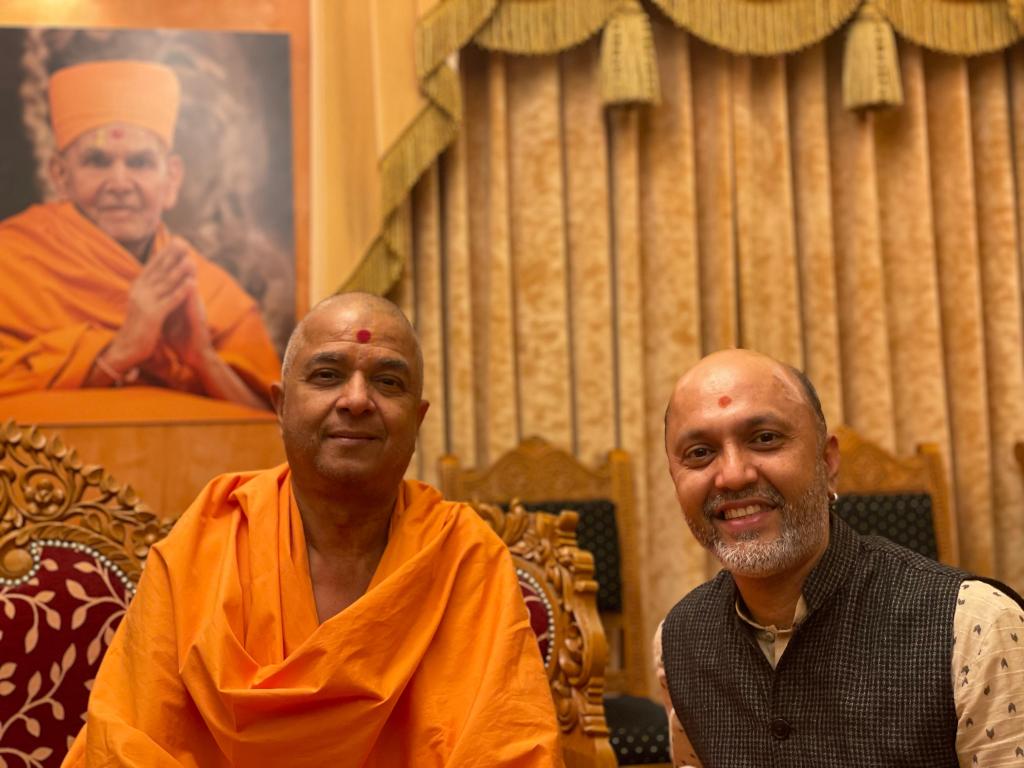
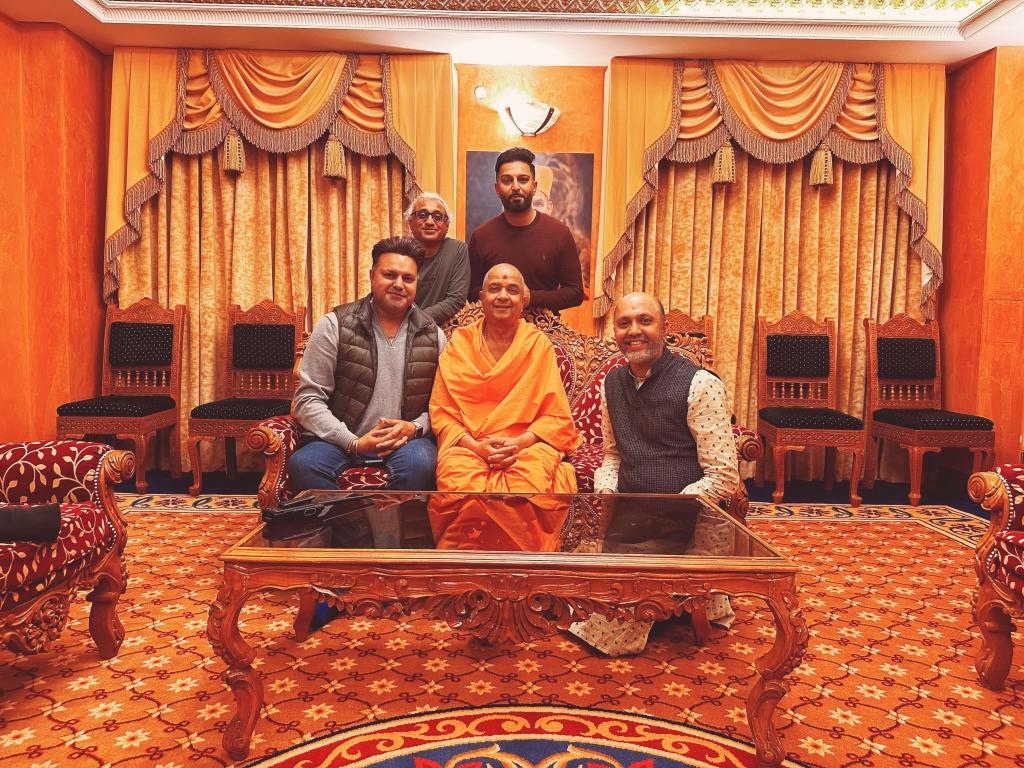
Left to Right – Sitting: Hiten Waghela, Pujya Brahmvihāri Swāmi, Bhavin Shukla [Neasden Mandir, London, 30th March 2024]
Please “like” 👍 and provide feedback in the “Leave a Reply” 📋 area (scroll down to the bottom of this page) if you enjoy reading the article ✍️. I would love to know if these are helpful and how I can improve it. If you find this blog site interesting then please remember to “subscribe” 🤝.
Bhavin Shukla has been working as an IT Consultant in the data space for more than 25 Years. As a Data and Analytics professional, he has worked extensively for years on complex IT Transformation Programmes within Healthcare, Finance, Insurance and Telco domains.
Bhavin is driven by a sincere desire to embrace a spiritual existence rooted in values, while genuinely striving to enhance societal culture by fostering a supportive community where we stand by each other.


 Bhavin Shukla
Leave a comment