During my University days, after lectures, I used to have Cutting Chai (half-cup tea) at our college Tapri (tea stall). One of my friends, Vikram, arrived, ordered his tea, and made a casual remark. I’m not sure under what circumstances he made the statement, but it became one of my life’s mantras. He said, “it is easy to make new friends but hard to maintain friendship with existing ones“. It clicked immediately and has always been with me.
One of the trading strategies in the world of stock market and financial investment is to buy a stock early on and instead of trading them in cycles, i.e., selling when the value increases and moving on to other shares, the idea is to hold on to them for a longer period of time by putting them in a drawer, forgetting about them, and checking their price after 15-20 years. This concept is known as Compounding Returns.
People who bought Amazon, Google, Apple, and other companies’ stocks early on and never sold them have amassed millions of dollars. It resulted in exponential wealth growth. Despite potential financial challenges, inflation, and money required to support the family, the decision to keep the assets safe resulted in amazing wealth growth.
Nurturing relationships is similar to this idea. It’s simple to check-in, make new friends, and check-out if we don’t like them anymore. However, sticking with the people we’ve been with and going through the ups and downs with them can make a difference in our lives.
A baby is born after nine months of gestation. If the infant is born prematurely, it can be difficult for it to survive. Similarly, every relationship requires a gestation period in order for us to comprehend one other; otherwise, we risk breaking up.
Roy Amara, an American scientist, once stated in connection to Nanotechnology, often known as Amara’s law,
“We tend to overestimate the effect of a technology in the short run and underestimate the effect in the long run.”
This tends to hold true in relationships as well. Sometimes we overestimate in the early stages of a relationship, and then when we start to understand each other, we underestimate and walk away from these lovely alliances.
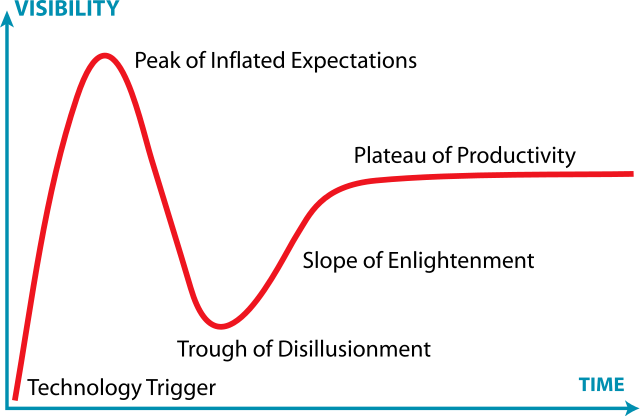
American technological research firm, Gartner, has developed a technology adoption methodology known as the Gartner Hype Cycle. This approach is used to determine the best entry point for every new technology or trend. However, I wonder if the framework may also be applied to relationships.
We meet new people and find them interesting. Then we choose to become close quickly and rush into relationships, which leads us to the Peak of Inflated Expectations in Gartner’s Hype Cycle.
Reality strikes, and we discover that we are incompatible, leading us to the Trough of Disillusionment.
We recognise later how much we miss these people on the Slope of Enlightenment, and then the Plateau of Productivity arrives, leading us to form lasting connections.
The majority of our relationships did not make it through the Trough of Disillusionment, so we quit. The aim here is to persevere with these people and relationships; otherwise, we may never get out of the Trough of Disillusion.
According to compounding returns theory, it would have cost someone £200 to buy a hundred Microsoft shares in 1990, and their current value is approximately £50k.
However, there is a caution, and the stock market teaches us this as well: invest in companies (relations / friends) that you believe in, because not every stock / company provides compounding profits, and quite a few might take you down with them.
So, choose your friends / acquaintances properly, and once you’ve done so, be sure to nurture these relationships, stick with them, and make them a part of your life, not just in times of success but also failure.
Why to limit these to friends and other relationships, can we not apply this with colleagues too? What do you think, trade in cycles or compounding returns? Please let me know in the comment section.






 Bhavin Shukla
Leave a comment