
Happy Women’s Day.
Women’s contributions should be acknowledged not just today but every day. However, today serves as a crucial reminder of why we should celebrate and honor them more frequently than we typically do.
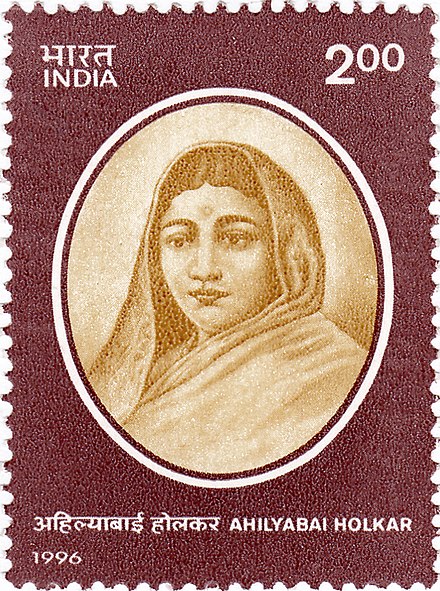
Ahilyabai Holkar (1725–1795), the Queen of Malwa, was born during the Mughal era, approximately 200 years ago, at a time when British influence in India was beginning to expand, and the Maratha Empire was gradually declining. She was the daughter in law of Malhar Rao Holkar, who served as a commander in the army of mighty Maratha king, Peshwa Baji Rao I.
Ahilyabai Holkar faced numerous personal hardships throughout her life. Widowed at a young age because of she losing her husband in the battlefield, she was spared from the practice of sati by her father-in-law, who encouraged her to rebuild her life instead. Following his father-in-law’s passing, her son ascended the throne but tragically died shortly after due to injuries sustained in battle. Her daughter chose to perform sati after the death of her husband, who also perished in battle.
Despite these hardships, Ahilyabai Holkar rose above them and ruled Malwa, present day Indore, for over 30 years. Ahilyabai is regarded as one of India’s greatest women rulers, renowned for her administrative expertise, exemplary governance, wisdom, and commitment to public welfare.
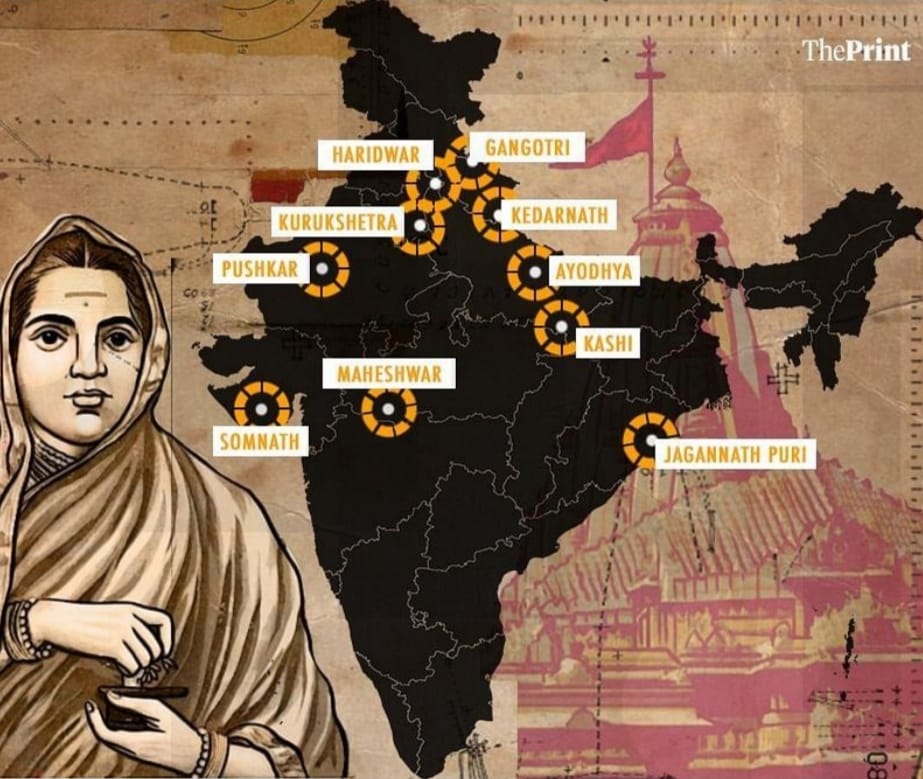
Ahilyabai Holkar played a pivotal role in the revival of Hindu culture through her dedication to restoring and constructing temples across India. She is credited with the reconstruction of numerous significant temples, including Shri Kashi Vishwanath in Varanasi (1780), Shri Somnath Temple in Gujarat (around 1783), Vishnupad Temple in Gaya, Bihar (1787), Gyanvapi Temple (around 1780), and the Grishneshwar Jyotirlinga near Ellora, Maharashtra.
Ahilyabai was also known as a Philosopher Queen. She dedicated much of her wealth to the restoration of temples, ghats, and pilgrimage centers across India, spearheading a movement that leading Hindu faith and culture
Her other major contributions to the welfare of the temples:-
| Temple | Location | Ahilyabai’s contribution | Additional Notes |
|---|---|---|---|
| Shree Kashi Vishwanāth | Banaras, Uttar Pradesh | She rebuilt the temple after it was destroyed by Aurangzeb | 12 Jyotirlinga |
| Shree Somnāth | Somnath, Gujarat | The idol was re-installed and the temple was renovated by her | 12 Jyotirlinga |
| Shree Rameshwaram Temple | Rameshwaran, Tamil Nādu | She made significant donations for the renovation and upkeep of this sacred temple | 12 Jyotirlinga |
| Shree Mallikarjuna | Srisailam Temple, Andhra Pradesh | She rebuilt the temple | 12 Jyotirlinga |
| Shree Omkareshwar | Omkareshwar, Madhya Pradesh | Made significant contributions | 12 Jyotirlinga |
| Shree Vaijnath | Beed, Maharashtra | She rebuilt the temple | 12 Jyotirlinga |
| Kedarnath, Badrinath, Ayodhya… And many more… | Various locations | Made significant contributions for restoration | Char Dham, Jyotirlinga |

Whenever the question arises about whether women should be allowed into a temple, one should first remember Ahilyabai Holkar—without her, many of the temples we see today might not have existed!
Happy Women’s Day.
 Bhavin Shukla
Leave a comment