
Mānas Rām Kathā: Morari Bapu’s Key Messages
Preserve Identity and Avoid Procrastination
An Introduction: Morari Bapu and Rāmkathā
Morāri Bāpu, also known simply as Bāpu, has been narrating Rām Kathā for nearly six decades. His distinctive approach to spiritual discourse involves reciting the story of Lord Rām using the granth (sacred book) Rāmcharitmānas, written by Tulsidās Ji. This unique method deeply connects with both the youth and the present generation.
Bāpu chooses a subject or theme for the nine-day spiritual discourse/talk.
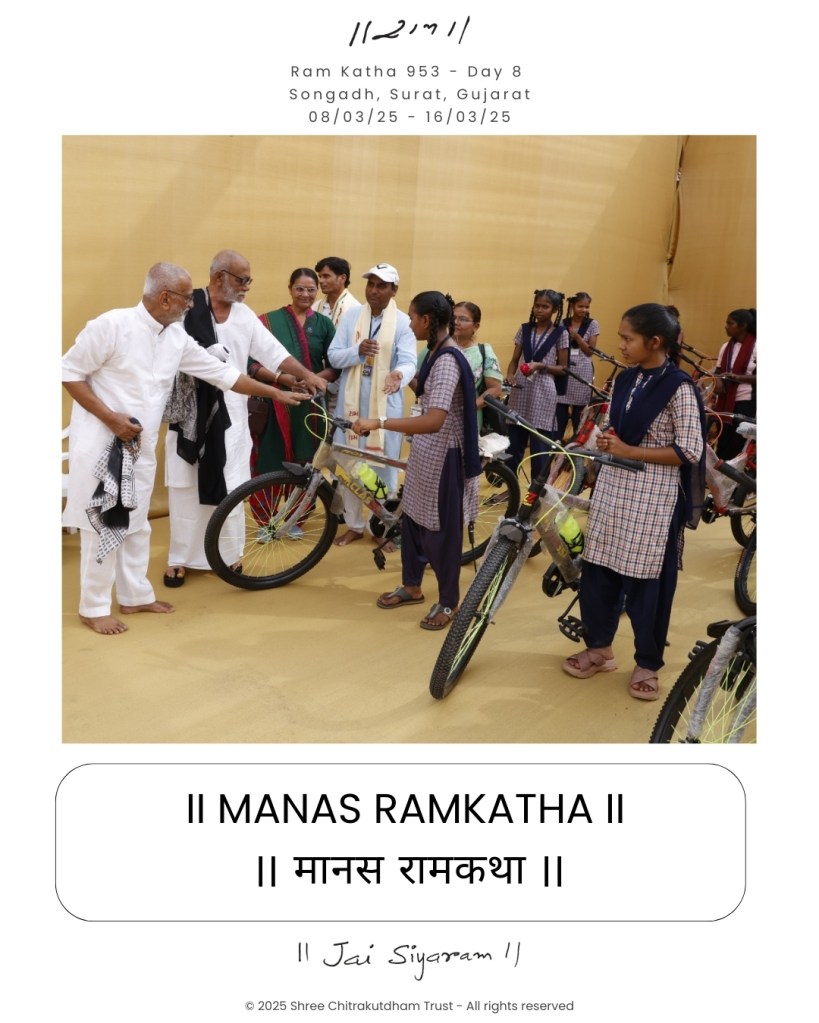
The theme of the recently concluded Rām kathā, which was held at Songadh, Gujarat from 08th March 2025 to 16th March 2025, was Mānas Rām Kathā.
Manas Ram Katha, Songadh, Gujarat
Bāpu mentioned during the katha on how the seeds of the Songarh katha were planted and how it came to shape.
Katha Theme / Katha Chopai
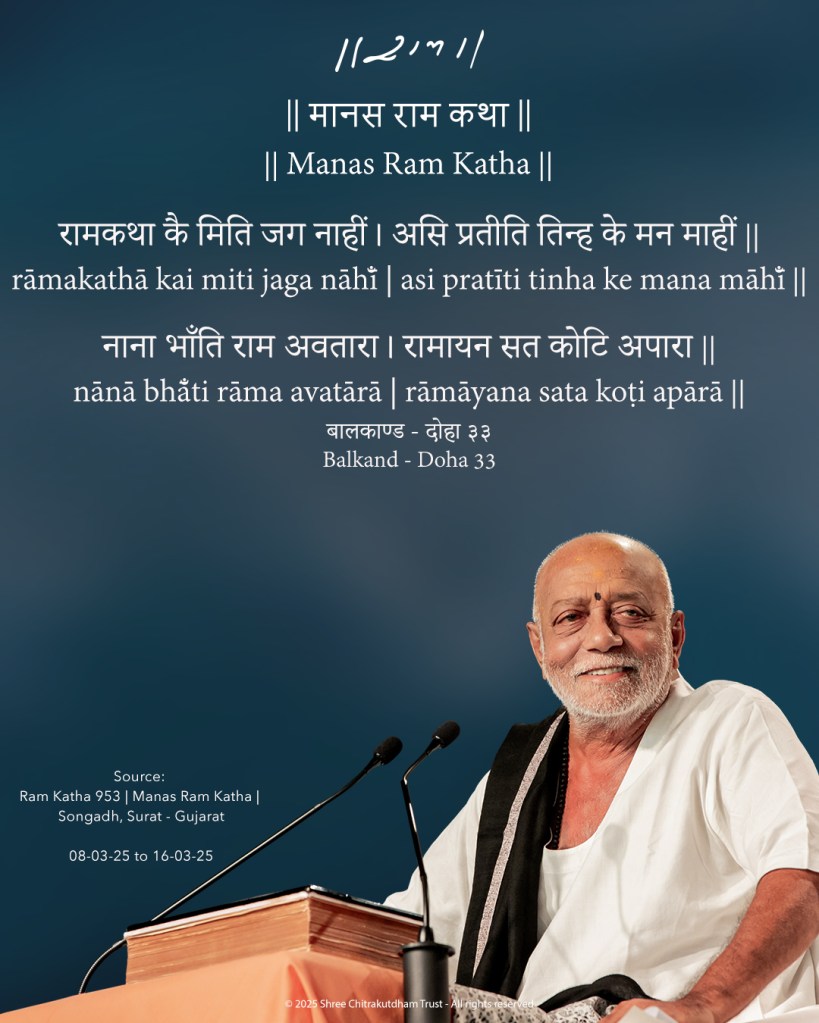
Apart from the core theme of Rām kathā, Bāpu selects one chopai (verse) from about 11,000 verses written by Tulsidās ji in his granth (book) Rāmcharitamānas, to serve as the primary kathā chopai pertinent to the subject chosen.
The one below was the katha chopai chosen for Mānas Rām Kathā.
रामकथा कै मिति जग नाहीं । असि प्रतीति तिन्ह के मन माहीं ॥
rāmakathā kai miti jaga nāhī̐ | asi pratīti tinha ke mana māhī̐ ||
नाना भाँति राम अवतारा । रामायन सत कोटि अपारा ॥
nānā bhā̐ti rāma avatārā | rāmāyana sata koṭi apārā ||
Chopai / Verse Meaning:
Bāpu explains that the Rām Kathā is infinite and boundless, with numerous versions of the Rāmāyan. Since Lord Rām is Brahm, the Supreme Being, He embodies three essential qualities: Divya (divine), Bhavya (universal), and Sevya (served). In essence, Divya signifies something eternally fresh, Bhavya represents that which is universally accepted, and Sevya refers to one whose very purpose is to serve. Bāpu has explained these concepts in detail during another Kathā, Mānas Rām Mandir.
Śri Rām and the Rām Kathā, His divine story, are both boundless and infinite. In Rāmcharitmānas, Tulsidās Ji expresses in this verse that he deeply believes (pratīti – प्रतीति) this to be true, rather than merely considering it as a personal opinion.
Manas Ram Katha – The Key Messages
Bāpu’s Rām Kathā is rich in wisdom, delivering profound messages over the course of nine days. It is believed that each listener receives a message uniquely suited to their own spiritual journey. Bāpu refers to this personalised receptivity as Pātratā i.e. one takes-in depending on the size and shape of their own vessel (pātra).
What I am going to describe below is a humble attempt on what I gathered from the kathā, based on my wisdom, spiritual journey and my eligibility i.e. my pātratā.
To me there were two key messages of the kathā,
- Preserving Identity – મૂળ ને પકડી રાખજો
- Avoid Procrastrination – પ્રમાદ થી બચજો
1. Preserving Identity
Bāpu is among the most influential thinkers of modern times. This Kathā took place in a remote tribal region, home to the Adivāsi community. However, Bāpu refers to them as Anādivasi, meaning “those who have been here since ancient times.” The Bhil people have also been residing in this area for many years.
Sadly, the people in the tribal area have been forgotten by the system, and their growth and development has been relatively slow when compared to the other urban parts of the country. The stagnation of growth has led the tribal belt to many financial and social challenges.
The nation’s politics and religious institutions have taken advantage of the tribal people’s vulnerabilities and needs. Religious groups are increasingly using incentives, miracles, and fear tactics to persuade people to quit their original religion (mool dharma), causing them to lose their identity and feel detached from their roots over time.
Some reports indicate that a specific religion via religious conversions is rapidly increasing in the Songadh area, where the Kathā was held, witnessing a significant demographic shift.
- The region has witnessed a substantial rise in religious conversions, especially in villages like Dosvada, where 61% of the population now follows that faith.
- In one village with a population of 3,000 residents, 95% are reported to be practicing that particular religion.
In response to the challenges faced by the local tribal communities, Morāri Bāpu celebrated their rich cultural heritage, highlighting their deep connection with Sur (melody) and Taal (rhythm). He repeatedly praised their musical and artistic traditions while reminding them of their glorious past. He cited the bravery of Birsa Mundā, a Bhil leader, who valiantly fought for his people and stood against the formidable British Empire.
During his discourse, he emphasised the need for the government to address the challenges faced by the local tribal communities amidst an ongoing cultural erosion, a concern that was also highlighted by state newspapers.
2. Avoiding Procrastination
Bāpu stated that pramād (procrastination) is the most serious aprādh (offense) in life. If someone is fully aware of their responsibilities yet chooses inaction due to laziness, it will only lead to their own decline and degradation.
He also highlighted that certain intellectuals (buddhijīvi) in society deliberately procrastinate when it comes to addressing societal challenges, as staying silent serves their own interests. He urged such individuals to step forward for the welfare of the underprivileged rather than only engaging in issues that benefit them personally.
Situations do not change merely by waiting for time to bring about change. If circumstances are within our control, every individual should take initiative, demonstrate leadership, and proactively take action.
Bāpu quoted a verse from the Bhagavad Gītā and emphasised that procrastination is equivalent to death.
Summary
Bāpu has done a Kathā in this tribal region a year ago in Khanda, Dharampur (Mānas Samvatsar), which gave him a deep understanding of the challenges faced by the local people and tribal communities. It was heartening to see spiritual leaders like Bāpu bringing attention to the issues arising from cultural genocide, often driven by political motives.
Bāpu stated that Rām Kathā is not meant to make you Pravin (clever) but to make you Pramānik (ethical and authentic).
While quoting a verse from Aitareya Brāhmaṇam (ऐतरेय ब्राह्मणम् – 7.10), Bāpu stated that life becomes truly fulfilling when Satya (truth) is embraced with Shraddhā (faith).
श्रद्धा पत्नी सत्यं यजमानः श्रद्धा सत्यं तदित्युत्तमं मिथुनं श्रद्धया सत्येन मिथुनेन स्वर्गाँल्लोकाञ्जयतीति

Shraddhā patnī satyaṁ yajamānaḥ, shraddhā satyaṁ tad ity uttamaṁ, mithunaṁ shraddhayā satyena, mithunena svargān lokān jayati iti.
The Rām Kathā brings supreme contentment (Paritosh – પરિતોષ) because it is the story of Rām (Satya – Truth) and Sitā (Shraddhā – Faith). In other words, the organisers’ Sankalp (resolve) to hold the Kathā is rooted in Satya, driven by their deep Shraddhā. Similarly, the listeners’ commitment to attending the Kathā is Satya, and their Shraddhā lies in their devotion to listening.
Faith (Shraddhā) supports Truth (Satya), just as a wife supports a husband in a yajña (sacred fire offering). Without faith, truth alone is incomplete, and without truth, faith is blind. Together, they lead to spiritual elevation and fulfilment of sacred duties.
Bāpu says that Lord Rām is the embodiment of Satya (truth), and all one needs is Bharoso (faith). Having unwavering faith in Śri Hari (one’s chosen Isht Dev – God) is enough to transform circumstances and instill the courage needed to stand against any injustice.
This union of truth and faith is the key to lasting happiness. It served as a message to the local tribal community, emphasising that Lord Śri Rām represents truth, and Mātā Sītā embodies faith. Keeping Rāmcharitmānas in their homes would instill courage and strength to navigate challenging times.
He emphasised that while he addressed the concerns of the local tribal communities regarding religious conversions, both he and his Kathā are meant for everyone. Upholding the principle of Vasudhaiva Kutumbakam (Sanskrit: वसुधैव कुटुम्बकम्), meaning “the world is one family,” his message extends beyond just the followers of Sanātan Dharma.
Bāpu also read out his purpose for visiting Songadh:
- I am here just to meet you (હૂં તમને મળવા આવ્યો છું)
- I have come not to protest (virodh) against anyone, but to share the wisdom I have learned (bodh) from my Gurus.
- I am not here to create controversies or disputes (Vivād) but to encourage healthy discussions (Samvād).
- My purpose is not to disrespect (Apvād / Durvād) but to sing the glory of Lord Rām (Gunānuvād).
- I have come for the benefit of society (Shubh), and not for my benefit (lābh). What greater Lābh could there be for me than to recite Rām Kathā?
- My intent is to accept everyone (Swikār) with an open heart.
- He urged the listeners not to use Rāmcharitmānas and the Bhagavad Gītā as weapons (Shastra) but as sources of wisdom and culture (Shāstra), encouraging regular study (Swādhyāya).
And if, despite this, anyone feels offended, Bāpu expressed his sincere apologies, emphasising that we are all one family. He also mentioned that he would revisit the region in a year for the same purpose.
Finally, he warmly invited everyone to visit Talgajarda, the village where he resides, saying:
“Haske aaya karo, haske bulaayaa karo, Talgajarda Bāp kā ghar hai, aaya jaaya karo,“ which means, “Come with joy, invite with joy—Talgajarda is your father’s home, feel free to visit anytime.”
This reminded me of our own visit to Bāpu’s place.
Jai Siya Ram.

Miscellaneous Notes:
While reading out the daily questions, he recalled Gandhi Bāpu, as it was the anniversary of the Dāndi Yātrā.
Bāpu cited various sāmājik pāp/aprādh (societal sins) as outlined by Gandhi Bāpu while responding to the question.
- Politics without principles is a social sin – Siddhānt vagar nu rājkāran e sāmājik pāp chhe, સિદ્ધાંત વિના નું રાજકારણ એ સામાજિક પાપ છે
- Wealth without hard work is a social sin – Parishram vināni sampatti e sāmājik pāp chhe, પરિશ્રમ વિના ની સંપત્તિ એ સામાજિક પાપ છે
- Pleasure from material indulgence without inner peace and contentment is a social sin – Āntarsukh ane bhitar ni prasanntā vagar ni bahar ni moj e sāmājik pāp chhe, આંતરસુખ અને ભીતર ની પ્રસન્નતા વિના ની બજાર ની મોજ એ સામાજિક પાપ છે
- Knowledge without character is a social sin – Chāritra veena nu gyān e sāmājik pāp chhe, ચરિત્ર વિના નું જ્ઞાન એ સામાજિક પાપ છે
- Business without ethics is a social sin – Niti vagar no vyāpar e sāmājik pāp chhe, નીતિ વિના નો વ્યવસાય એ સામાજિક પાપ છે
- Science without compassion is a social sin – Samvednā veenā nu vignān e sāmājik pāp chhe, સમવેદના વિના નું વિજ્ઞાન એ સામાજિક પાપ છે
- Worship without sacrifice is a social sin – Tyāg vagar ni pujā e sāmājik pāp chhe, ત્યાગ વિના ની પૂજા એ સામાજિક પાપ છે
I have noted the above, which, while not directly related to the Kathā, serves as a guiding light for how one should live their life for the benefit of the society.
Mānas Rām Kathā – Gallery




 Bhavin Shukla
Leave a comment