
Topic: Truth Beyond the Headlines
Date: 31st May 2025
Location: Leicester, UK
Organiser: Insight, UK
Keynote: J. Sai Deepak
Introduction
It’s not every day you get to listen to someone who bridges the gap between law (Indian Constitutional Law), Indian history, and Indian national identity with such precision and conviction. I recently had the opportunity to attend a thought-provoking talk by advocate and author J. Sai Deepak ji, and it turned out to be far more than just an academic lecture.
Having started his career as an engineer, then moving into law, and eventually becoming a well-regarded author and commentator on civilisational issues, Sai Deepak ji’s personal journey alone sets the stage for the depth he brings to public discourse.
It was interesting to note from his lecture that his three generations have been in the engineering field, but he chose to cast away and study law, which also shows his rebel nature and questioning of the status quo.
Themes and Key Takeaways
The Humanities as a Tool for Truth
Sai Deepak ji made a compelling case for why Indians need to move beyond STEM fields and engage more deeply with the humanities. History, philosophy, political theory – these disciplines are crucial, he argued, if we are to reclaim and correctly interpret our own civilisational narrative.
In a way, what he meant was one cannot decolonise a society unless the mind has been decolonised in the first place. This is because the history has been written by the people in power, and it may not be depicting a true picture of the past.
Bharat vs. India: A Constitutional Framing
One of the talk’s more striking moments was when he described how his use of the word “Bharat” initially raised eyebrows. His response? He simply pointed to Article 1 of the Indian Constitution: “India, that is Bharat…”
He encouraged the audience to see this not as a cultural or religious assertion, but as a constitutional identity. By reclaiming this framing, he believes Indians can better navigate issues of representation and selfhood in global discourse and showed how the community can become stronger and more confident on the back of acquiring the right knowledge.
From Non-Secular Kingdoms to Secular Indian Democracy – the Real Story!
Perhaps the most intellectually stirring part of the evening was Sai Deepak ji’s exploration of India’s transition from a series of princely states or provinces, often organised along religious and ethnic lines, to a secular democratic republic.
He raised important questions:
- When the inherent fabric of the country at the provinces or princely state was non-secular, then how come the umbrella, i.e., the union of the federation, became secular?
- How did this transformation occur so rapidly post 1947?
- Was the concept of secularism truly home-grown, with some people in power having vested interests, or externally imposed?
- Can we fully understand modern India without revisiting the stories of those who resisted colonial and religious conquest?
His Personal Journey
The above questions were instrumental to starting his quest to challenge the status quo and stand up for the cause.
What makes Sai Deepak ji’s message all the more powerful is that it’s rooted in personal exploration.
He spoke candidly about how his curiosity in Indian history stemmed from gaps he encountered in legal arguments, especially around constitutional law. His legal training, paired with a passion for decolonial thinking, led him to research India’s past from a fresh lens.
He pointed out that for the first seven years of his career, he did not speak at any events, and his only goal was to accumulate knowledge, understand and grasp the subject, and get ready for it to be presented with his own interpretation. After which, he wrote a book of trilogy: India that is Bharat: Coloniality, Civilisation, Constitution
Rewriting History – Sai Deepak Way (Facts)
He challenged the narrative being imposed on the Indians that the British ruled India for more than 200 years. He quoted the Battle of Plassey, which was fought in 1757, which won only old Bengal, which was just a part of India, or Bharat, as it was at that time.
The Marathas kept fighting all the way till 1818, when the Third Anglo-Maratha War ended. The Anglo-Sikh wars happened in the 1840s and gave the British Empire real resistance.
This means that the British Empire only came to power after 1857ish, meaning it did not rule India for even one hundred years (1857 to 1947).
He drew on the legacy of leaders like Chhatrapati Shivaji and the Maratha Empire as symbols of indigenous resistance and linked them to the cultural consciousness of Bharat, which is the Hindutva DNA within the origins of the people of the Indian subcontinent.
This brought the focus on Hindutva, which was the most awaited discussion, at least for me!
Hindutva
He mentioned that it was not Shri Savarkar who coined the word Hindutva, but it was Shri Chandranath Basu in 1892 who first mentioned Hindutva in his book, Hindutva -Hindur Prakrita Itihas.
He also enlightened the audience about the difference between Shri Savarkar’s Hindutva, which was more nationalist, and Shri Basu’s Hindutva, which was more civilisational and cultural.
He drew attention to how religion is different from the dharma, and Hindu is a dharma and not a religion. The “tva” in Hindutva represents the actual character or quality of being a Hindu; this was from the cultural civilisational point of view.
Audience Reaction
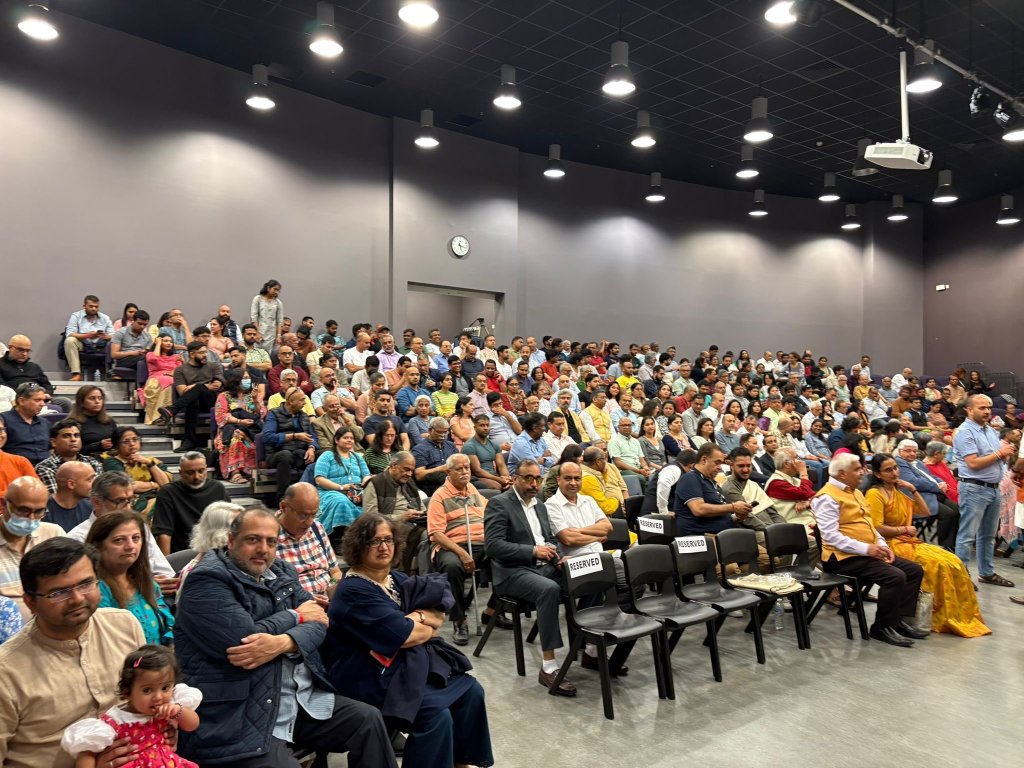
The talk was met with enthusiastic applause, and the Q&A session was lively. Audience members, both young and the older community leaders, engaged deeply, asking questions about everything from education reform to geopolitical identity.
One question from a twelve year boy, and the answer to his question was quite interesting: https://x.com/INSIGHTUK2/status/1929180291362427001
Critique – Truth Beyond the Headlines
Did I learn anything new about Hindutva or Sai Deepak ji’s definition of Hindutva? Unfortunately, the answer is negative. Personally, I don’t think there was any new content that I could take home from what I already had.
Possibly the 45 minutes of time allocated was too short, as it was a difficult subject to educate the audience, who would not be aware of Indian history, the Plasseys, Anglo-Maratha Wars, Anglo-Sikh Wars, etc, and then link them to their cultural identity (British Indian!) via the lens of modern India, which they are out of touch with, was a big ask.
At one point, I felt that Sai Deepak ji contradicted himself. He, in the main speech, mentioned the difference between religion and dharma, but then during the question answer sessions, some of his answers had a bit of religious flavour rather than dharmic. Some of the solutions he proposed for retaining identity, or Hindutva, were to ensure that we pray to the 32 (koti) Hindu gods; putting a tilak is a significant symbolic identity that everyone should comply with and should be unashamed of.
Final Thoughts
Attending this talk left me with more questions than answers – and that’s perhaps exactly what Sai Deepak ji hoped for. Instead of providing ready-made answers, it is better to leave the audience with questions that will take them on their own quest. I am now more eager than before to know what Hindutva means for the new Bharat!
He called this the Soda Effect. The soda loses the fizz immediately after it’s popped, meaning people will get too excited after the talk, but not much will happen once they settle down to their normal selves.
In an age of soundbites and instant takes, it’s rare to encounter someone willing to challenge dominant narratives with such clarity and courage.
For those in the diaspora who’ve long felt a disconnect between their cultural heritage and global identity, his message was clear: start reading, start questioning, and don’t be afraid to reclaim your roots.
Another important point he raised was that Bharat no longer needs any help, especially in terms of remittances, from the persons of Indian origin (PIO). The new Bharat is self-sustainable and can play the role of the hub for the spokes/satellites living outside of the physical Bharat.
The role he wants the PIOs to play was to live the culture as laid out by the original Hindu civilisation, and the person can be of any religion. He wants the PIOs to challenge the incorrect narratives of India, Hindu, and Hindutva being shaped outside of India. This can be achieved if the PIOs are in the top positions and do well in the country of their residence, but by following the law of the land. In his words, “It is good to be kind, but there is no need to be nice!”
Jai Hind!
Photo Gallery:

 Bhavin Shukla
Leave a comment