Do you know of a sampradāya (a religious sect or congregation) that treats everyone equally – without discrimination of any kind, whether between men and women, the privileged and the underprivileged, followers and non-followers, or VVIPs and others?
Have you come across a tradition that is nearly a thousand years old, yet still lives by its core principles of humility and selfless service?
Have you ever seen the head of a spiritual lineage send a disciple to learn from, and share, the teachings of an entirely different belief or culture?
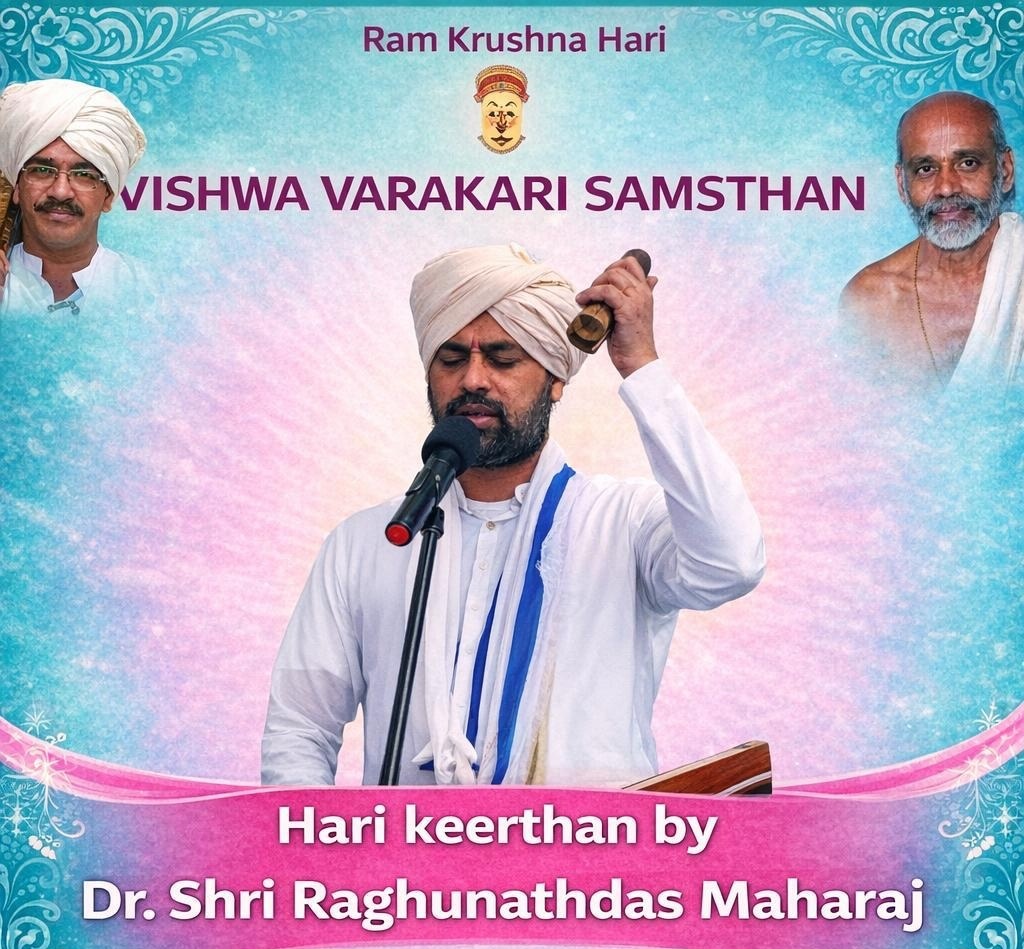
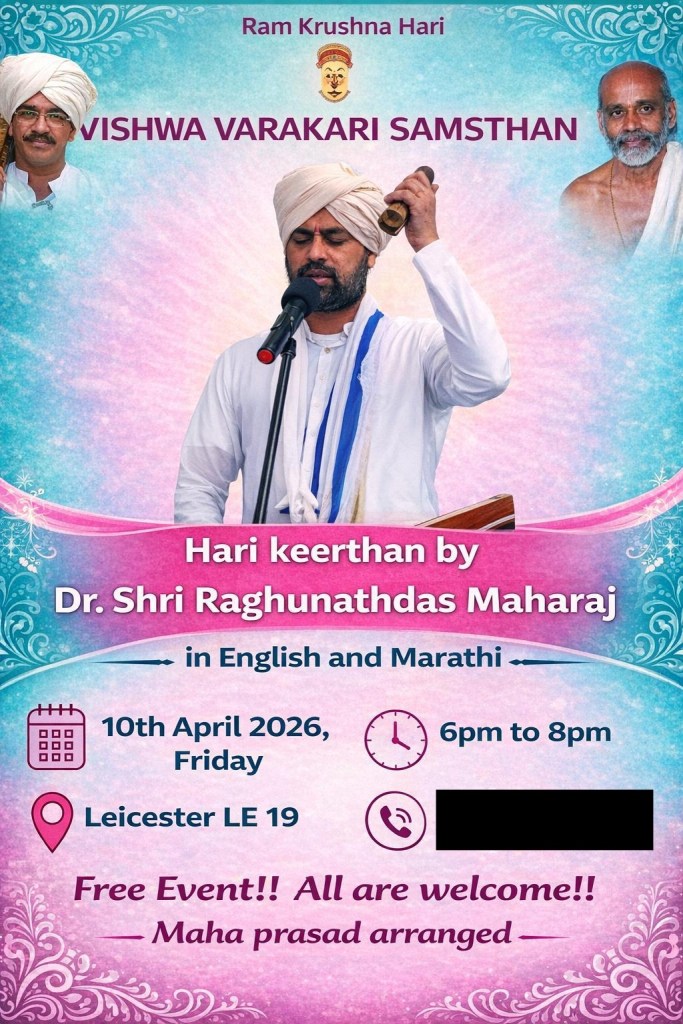
I feel I stumbled upon that rare treasure while attending a bhajan (keertan) gathering in Leicester, by Sri Raghunathdas Maharaj ji of Vārakari sampradāya that was initiated by sant Dnayeshwar Mahārāj ji born in 1271 AD.
I went in to the event with high expectations – but what I experienced went far beyond anything I could have imagined.
Cultural Diversity
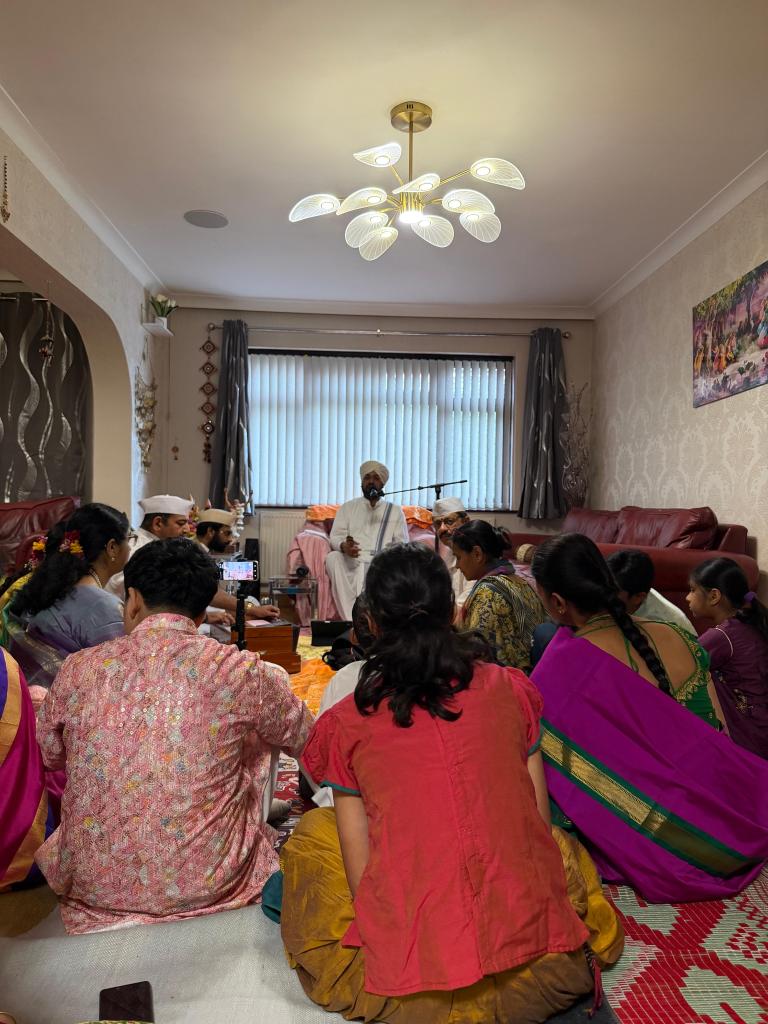
It was an evening gathering where devotees came together to take the name of Lord Vishnu. It is worth noting that “Vishnu” signifies the all-pervading – that which encompasses everything that exists and even that which does not. In this sense, Vishnu is not limited merely to the idea of a Hindu deity, but points to a universal presence.
The devotional songs (bhajans) were sung in Marathi, in the traditional form known as abhang. The lead singer, Śrī Raghunāthdās Mahārāj, demonstrated remarkable command on the subject and the language – with Tamil as his mother tongue, a PhD in Sanskrit, and a beautiful command of Marathi while singing the abhangs. The event itself was organised by our good friends, Sumathi and Raja, who are also Tamil.
As a Gujarati attending this event, it felt like a perfect khichdi – a wonderful blend of cultures and traditions, coming together in harmony.
Hari Nām Keertan
Śrī Raghunāthdās Mahārāj, referred to as Mahārāj ji among the devotees, began the programme with Hari nām keertan – repeatedly chanting “Rām Krushna Hari”, accompanied by the pakhwaj (Indian drums) and harmonium. It was both mesmerising and deeply soothing.
Mahārāj ji then chose an abhang composed by the well-known saint, Sant Tukārām. I hope to write in more detail about Sant Tukārām, Sant Dnyāneshwar, and the Vārakāri sampradāya another time, as it would otherwise make this write-up far too long.
Only one abhang was taken up for the entire session. The gathering sang it together throughout, while Mahārāj ji explained its meaning, drawing on scriptural references such as the Bhagavad Gītā.
मुनि मुक्त झाले भेणें गर्भवासा ।
आम्हां विष्णुदासां सुलभ तो ॥१॥अवघाचि संसार केला ब्रम्हरूप ।
विठ्ठलस्वरूप म्हणोनियां ॥ध्रुवपद॥पुराणीं उपदेश साधन उद्भट ।
आम्हां सोपी वाट वैकुंठींची ॥३॥तुका म्हणे जनां सकळांसहित ।
घेऊं अखंडित प्रेमसुख ॥४॥Muni mukta jhālē bhēṇē garbhavāsā |
Āmhā Viṣhṇudāsā sulabh tō ||1||Avaghāchi sansār kēlā brahmarūpa |
Viṭhṭhalasvarūpa mhaṇōniyā ||Dhruva pad||Purāṇī upadēsh sādhan udbhāṭa |
Āmhā sōpī vāṭa Vaikuṇṭhīchī ||3||Tukā mhaṇē janā sakḷānsahit |
Ghēū akhaṇḍit prēmasukha ||4||
Meaning of the Abhang
Tukārām Mahārāj explains in this abhang that for anyone seeking liberation (moksha or nirvāṇa), there is a simple and direct path. By merely taking the name of Vitthal (Vishnu), one can be freed from the cycle of birth, death, and rebirth.
There are many learned saints (munis) and realised beings who have undertaken intense penance and various forms of yoga to attain liberation. However, for devotees, simply chanting the name of Vitthal (Hari – another name for Vishnu) is enough to reach that state.
The second stanza (the dhruvapad) explains how this is possible. When one begins to see the Lord in everything, one becomes one with existence itself. The sense of “I” or ego dissolves; distinctions such as likes and dislikes, pleasure and pain, begin to fade. This leads to a state of constant inner contentment and peace — which is liberation itself, reflecting the philosophy of Advaita (non-dualism).
The third stanza highlights that while the scriptures (Purāṇas) describe many spiritual paths and practices, they are often difficult to follow and sustain. In contrast, the path of bhakti – devotion – is simple, accessible, and natural.
Mahārāj ji also quoted several verses from the Śrīmad Bhagavad Gītā, reinforcing the central message of this abhang.
Note: The second stanza is marked as the dhruvapad, which is the part repeated after every verse when the abhang is sung.
Summarising
Everyone expressed their gratitude to Mahārāj ji and the team for travelling all the way from India to share this wisdom. They sang and played beautifully. However, in Mahārāj ji’s words, they were not there to perform, but to take the Lord’s name and to share this understanding – that simply by chanting His name, one begins to see Him in everyone, helping to reconcile all differences.
For me, there were several “aha” moments, but my favourite was when Raghunathdas Mahāraj ji said, while explaining, “Is it not so beautiful to see everything as one (Vitthal), and yet to keep ourselves separate from Him so that we can sing His glory?”
The way I understood this was as a beautiful convergence of non-dualism and dualism – a kind of unity between the philosophies of Dvaita and Advaita. We recognise everything as one with Him, and yet we also choose to see Him as distinct from ourselves, so that we can experience devotion and sing His praises, while still seeing Him in everyone.
The prasādam (divine food) served after the event was delicious. We had some lovely discussions over dinner, and one that will stay with me was with Swetha ji. She explained why Sant Dnyāneshwar is also lovingly referred to as “Mauli”. In Marathi, Mauli means “mother”, but with a subtle distinction – the word for one’s own mother is aai, whereas Mauli refers to someone who is motherly towards everyone. Sant Śri Dnyāneshwar Mahārāj ji shared his wisdom with all, as though everyone were his own, and that is why he is called Mauli.
This insight beautifully connects to the final verse of the abhang: “तुका म्हणे जनां सकळांसहित । घेऊं अखंडित प्रेमसुख”. Tukārām ji calls out to everyone – not just his own followers, or those of the Vārakāri sampradāya, or only the devotees of Vishnu – but truly to all. He invites everyone to take Vitthal’s name, promising a lasting and boundless joy.
This, perhaps, is the essence of the Mauli tradition – one that brings everyone along, where no one is left behind.
Ram Krushna Hari!
Glimpses
 Bhavin Shukla
Leave a comment