Pragyāvān Bhakti – Mānas Guruvaryam
Logical simples are difficult to describe, they can only be experienced. Similar to this, it is challenging to convey in words what “Bhakti” means. Bhakti is the love between the one being prayed for, and the one offering the prayers. The two have an emotionally connected love that is neither sensuous nor material, nor is it one-sided. Both the one being prayed for, the Bhagwān (God), and the one offering the prayers, the Bhakt, are committed to one another. In this regard, Bhagwān’s devotion is equal even if we tend to refer to the bhakt as a devotee.
The origin of Bhakti and its earliest documentation date back thousands of years, there are references in Upanishads and Bhagwad Gitā about Bhakti, e.g. Bhakti Yogā is narrated in Chapter 12 of Bhagwad Gitā. The Bhakti Yogā chapter describes different forms of worship and the qualities of a true devotee that can lead to spiritual growth and realisation.
India has seen numerous social reforms, and quite a few of these are linked to the Bhakti movement. It has also influenced the development of the Indian philosophy (Darshan) of Vedanta, Dwait (dualism) versus Advait (monoism), and the relative merits of Nirguna (formless or property-less) and Saguna (the one with properties), among other beliefs. The Bhakti movement in India peaked between 15th and 17th century, during which time many well-known saints, like Meerā bāi, Goswāmi Tulsidās ji, Kabir dās ji and Guru Nanak ji, lived. Guru Nanak ji founded the Sikh faith in the fifteenth century.
Formula: Bhakti = Shraddhā + Vishwās
The question is, how can we bring bhakti in our lives and bring positive changes at an individual level? This is made clearer by Goswami Tulsidas ji’s in his granth (book), the Ramcharitamanas.
भवानीशङ्करौ वन्दे श्रद्धाविश्वासरूपिणौ ।
याभ्यां विना न पश्यन्ति सिद्धाः स्वान्तःस्थमीश्वरम् ।।२।।
bhavāniśańkarau vande śraddhāviśvāsarūpiNau,
yābhyām vinā na paśyanti siddhāh svantahsthamiśvaram (2)
Meaning, “I greet Goddess Pārvati and Her consort, Bhagavān Śańkar, embodiments of reverence and faith respectively, without which even the adept (most skilled) cannot perceive God enshrined in their very heart” 1.
Here Shraddhā (reverence) is the manifestation of mātā Pārvati, and Vishwās (faith) of Bhagwān Shankar. To have Bhakti, the two components, Shraddhā and Vishwās, are must. Shraddhā and Vishwās may look similar in meaning, but they have subtle differences. While Vishwās is a trust toward someone or something that a person is aware of, Shraddhā is about blindly trusting of something that the person may not have experienced it before. As an example, Shraddhā in God denotes a belief in God’s existence. However, if God were to manifest as an avatar and declare while standing in front of the same person, “I am the one you have been searching for,” would that individual still have faith in what God is saying? This is Vishwās 2. In order to become a Bhakt, a person must possess both Shraddhā and Vishwās.
The Origin of Bhakti: What does Shāstra say?
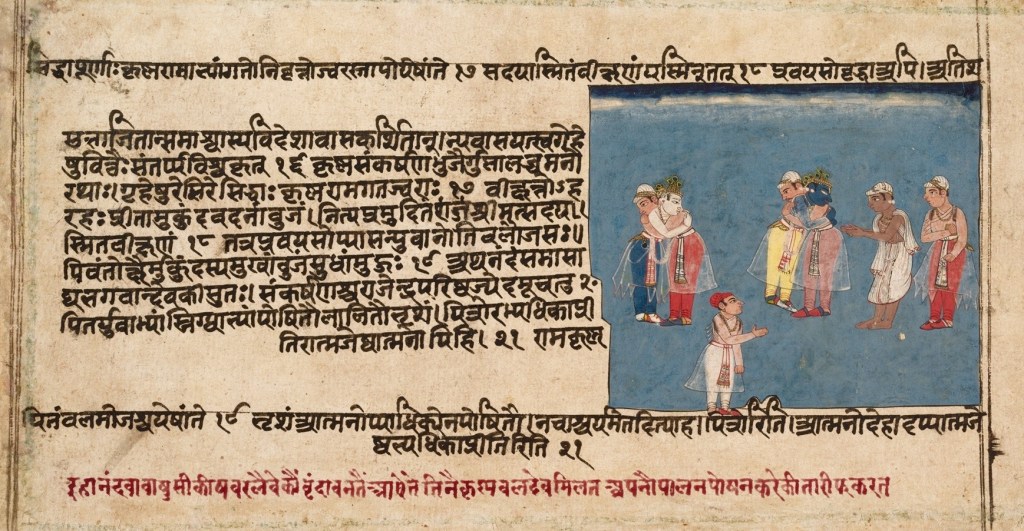
The learned people who reads Bhāgvad kathā from Bhagwat Purāna, mentions that Bhakti originated from southern part of India, i.e. Dakshin. 3
उत्पन्ना द्रविडे साहं वृद्धिं कर्णाटके गता ।
क्वचित्क्वचिन्महाराष्ट्रे गुर्जरे जीर्णतां गता ॥ ४८॥
Utpanna dravide sāham
Vriddhim karnāTake gata
Kvaćit kvaćit maharāshTre
Gurjare jirNatam gatā (48)
Meaning: Bhakti says that she was born in the Dravida or Tamil country, grew up in Karnataka and became old in Gujarat.
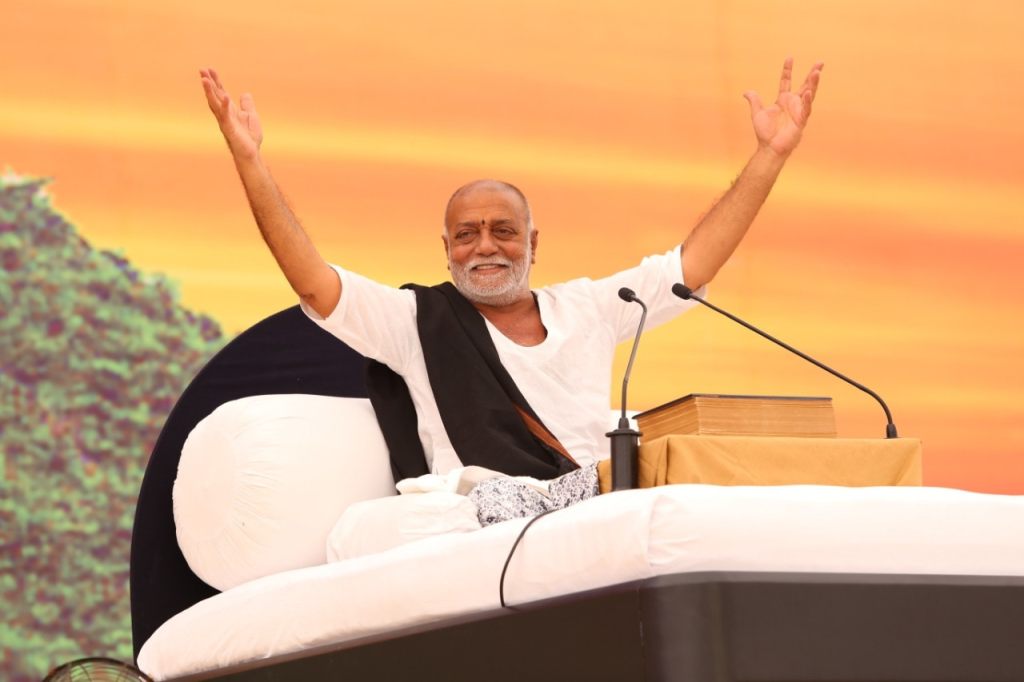
According to Pujya Morari Bapu, Bhakti did not age in Gujarat4. How can Bhakti grow old in a place where saints such as Narsinh Mehta appeared? He states that the context in this instance should not be interpreted as “old,” but rather as “matured,” meaning that Bhakti developed and became mature (प्रौढ) in Gujarat.
Sanātan dharma has always given space for interpretation and improvement in understanding, depending on which era it is being looked upon from. Over thousands of years, the saints who have devoted their lives to serving the dharma have accomplished more for the benefit of the society than what was anticipated of them. According to Pujya Morari Bapu, there are three types of servants as described in Valmiki Ramāyan: those who go above and beyond (Uttam Sevak), those who perform as expected (Madhyam Sevak), and those who fall short of expectations. Using Hanumān as an example, who was sent to Lanka to find mātā Sitā, Hanumān not only checked of her whereabouts but uprooted a few trees on his way back to intentionally get into conflict with Ravan’s army, which was to ascertain opposition’s might.
Pragyāvān Bhakti and The Role of Guru
Morari Bapu goes on to say that while bhakti on its own is good, there is further room for improvement, and that is why Pragyāvān Bhakti is necessary5. What is needed is a bhakti composed of wisdom, not just blind trust. His explanation makes sense because, in the Gita, otherwise there would only have been one chapter on yoga—Bhakti yoga—while Śri Krśna discusses Sānkhya yoga in chapter two, Karma yoga in chapter three, Gyān and Vigyān yoga in chapter seven, and so on.
This is where the role of guru (spiritual guide) is important. In order to develop the wisdom (Pragyā) necessary to identify Śri Rāma when he appears in front of you, one must first acquire the Śhraddhā and Viśwās for their own guru. When Śabri saw Śri Rāma at her doorstep, she forgot for a moment that Bhagwān was standing in front of her. This was due to her happiness that the word given by her guru, that Śri Rāma will visit her one day, had come true on that particular day. Even with Śri Rāma in front of her, she was still thinking about her guru. Rāma only visits places of such devotees. This is the essence of the Manās Guruvaryam Rām kathā. God dwells in the hearts and homes of those who puts their guru before God, i.e. Guruvaryam, because it is the guru that starts the journey and shows how to get to the light that can bring them out of darkness (ignorance) – तमसो मा ज्योतिर्गमय.
तुम्ह तें अधिक गुरहि जियँ जानी । सकल भायँ सेवहिं सनमानी ॥ [अयोध्याकाण्ड – दोहा १२९]
गुर बिबेक सागर जगु जाना । जिन्हहि बिस्व कर बदर समाना ॥ [अयोध्याकाण्ड – दोहा १८२]
tumha te̐ adhika gurahi jiya̐ jānī | sakala bhāya sevahi̐ sanamānī || Ayodhyakand – Doha 129
gura bibeka sāgara jagu jānā | jinhahi bisva kara badara samānā || [Ayodhyakand – Doha 182]
The lines mentioned above are from Manas Guruvaryam Rām Kathā’s main katha chopai. In the first verse, Bhāgwān Rām asks guru Vālmiki where he should live during his 14 years of vanvās (exile), having just begun his journey. The words given by Guru Vālmiki state that, He should reside in the place (heart) of a person who genuinely believes that their guru is even superior to Him (Rāma), i.e. Guruvaryam. In the second verse, Śri Bharat ji, Ram’s brother, describes his guru, Rām, as vivek sāgar, as an ocean of intellect. The intellect that is similar to a swān (hansa) that can separate milk from water, his guru has the capability of separating good from evil.
Ramcharitamānas Granth, Guruvaryam
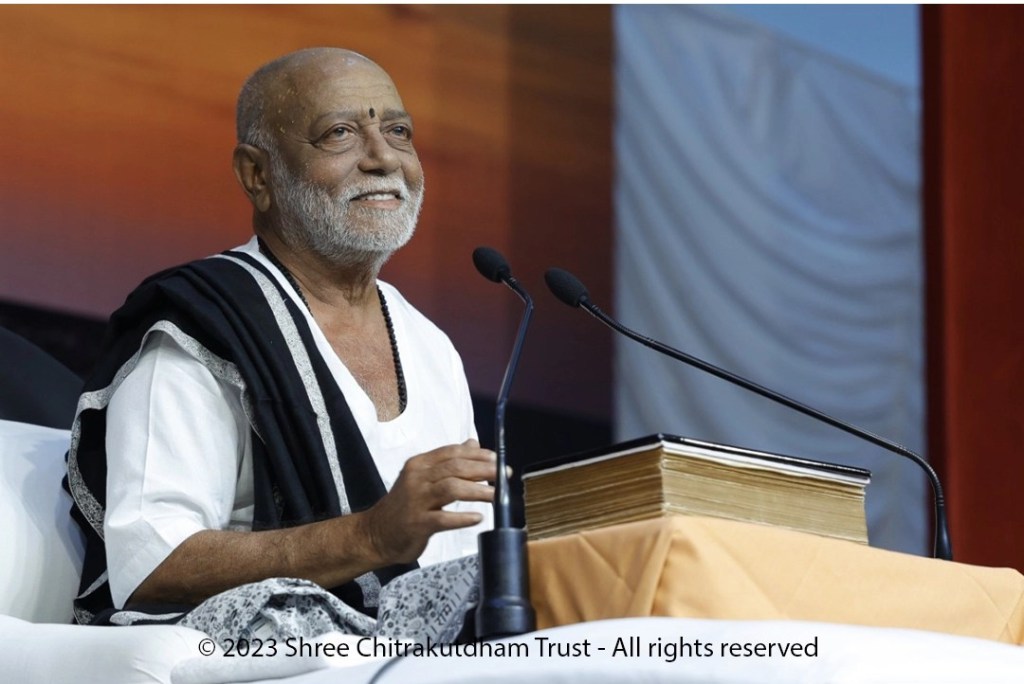
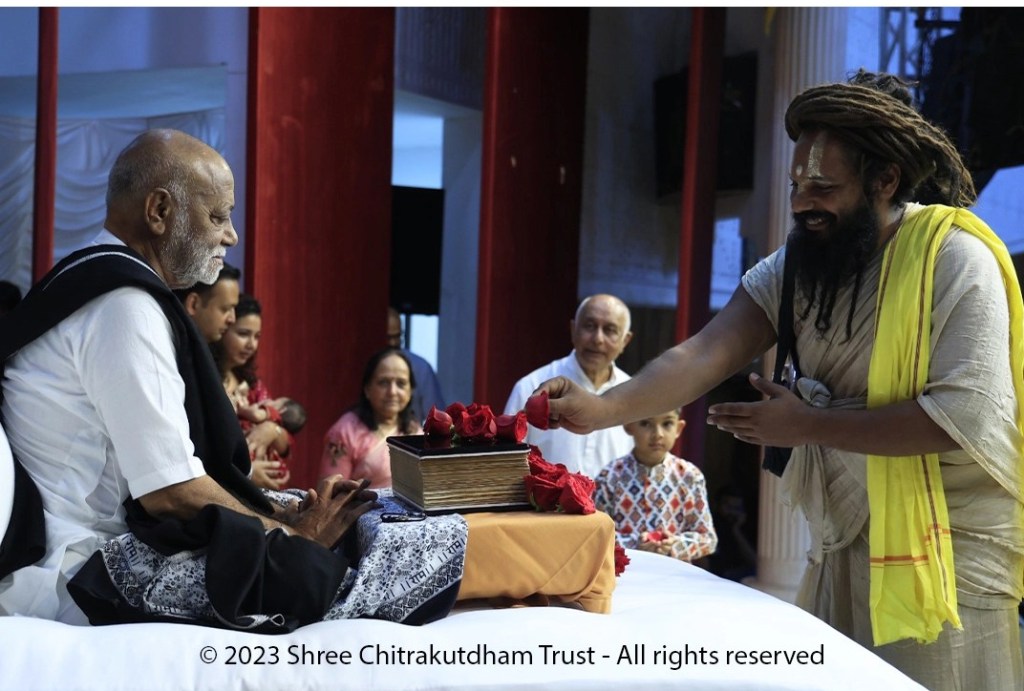
Pujya Morari Bapu says that, a Granth (spiritual book), e.g. Rāmcharitamanās can also be viewed as a guru and guruvaryam. This is the beauty of Indian tradition and spiritual growth (dharohar). Even though Bapu thinks Narsinh Mehta is amazing, he adds on top of Narsinh Mehta. According to Bapu, the well-known bhajan “Vaishav Jan to” by Narsinh Mehta advises us to build our character in a way so that we can see other people’s problems, “peeD parāyi”, in order to identify opportunities for how we might help and be kind to others.
वैष्णव जन तो तेने कहिये,
जे पीड परायी जाणे रे ।
VaishNav jan to tene kahiye
je peeD parāyi jāNe re |
He says, however, this journey should begin with an understanding of the faults and shortcomings within our ownselves, “peeD āpaNi”, so that we can understand others in a better way, i.e. charity begins at home. He goes on to explain how reading, reciting and understanding Rācharitamānās assists in converting the six evils/faults, known as Arishadvargas or shadripu (षड्रिपु), within us into six virtues6:

1) Kāma/काम (lust) gets transformed into Rāma/राम (bhakti);
2) Krodha/ क्रोध (anger) gets transformed into bodha/बोध (knowledge);
3) Lobha/लोभ (greed) gets transformed into Kshobha/क्षोभ (repentance);
4) Mada/मद (pride) transforms into paramapad/परमपद (higher destination, purposeful work);
5) Moha/मोह (temptation) to Neh/नेह (love); and
6) Matsarya/मत्सर्य (envy, jealousy) to padpar/पदपर (principled living – dharm anusār jeevan)
Concluding Remarks
In a separate katha, Bapu once stated that the ancient and time-tested knowledge preserved in texts as the Rāmcharitamānas, referred to as “granth” (pious book) aids in eliminating “granthi” (biases) from our minds. Eliminating our prejudices is arguably the largest and most crucial step in eradicating boundaries between the “I” and “you,” and ultimately realising that everything and everyone are one (Advait). If the Rāmcharitamanas can assist in this, then it is definitely Guruvaryam; all we need is Shraddhā and Vishwās in our hearts for bāpu and his teachings in order to do the unimaginable, namely, to become bias-free.
सीय राममय सब जग जानी।
करउँ प्रनाम जोरि जुग पानी।।
Siya Rāmmaya sab jag jāni,
Karau pranām jori joog pāni.7
As stated in Rāmcharitamanas with Guruvaryam in my mind and heart, and the mesage I received from the birth place of Jagadguru Śankrāchārya, my only prayer would be, “May I see the Rām tatva (Brahm) in everyone and everything, transitioning me from Dvait (me and you) to Advait (we), which will eventually make me bias free”.
Bharoso…dridh in charanan kero.
Jai Siyā Rām.
Please, Share, Like and Subscribe
If you have enjoyed reading the write-up ✍️, please “like” 👍 and leave your feedback in the “Leave a Reply” 📋 section (scroll down to the bottom of this page); I would love to know if these are useful and how can I make it better. If you find this place interesting then please do not forget to “subscribe”🤝. Any recommendations on future topics that you want me to cover then please let me know. I may not know about it but I am an ardent reader 📚, and have a knowledgeable network of friends/colleagues, so I can definitely try and find the answer for you.
References
- Śri Rāmacaritamānasa, Gita Press, Gorakhpur ↩︎
- Sri Swami Nischalanand, Govardhan math, Puri, https://youtu.be/VmNWzDv6KCE?si=NqrkSOLaD47ceE2h ↩︎
- Adhyāy 1, Verse 48, Bhāgwat Purāna, ↩︎
- Morari Bapu, Mānas Guruvaryam, Day 8, Ramkatha 927, Guruvayur: https://www.youtube.com/watch?v=HrBK4mk2ETI ↩︎
- Morari Bapu, Mānas Guruvaryam, Day 8, Ramkatha 927, Guruvayur: https://www.youtube.com/watch?v=HrBK4mk2ETI, at 02:57:00 ↩︎
- Morari Bapu, Mānas Guruvaryam, Day 9, Ramkatha 927, Guruvayur: https://www.youtube.com/live/xo-lNR1n1UY?si=YNxMVCyRbIAJDKVx ↩︎
- Śri Rāmacaritamānasa, from Bal Kānd ↩︎
About the Author
Bhavin Shukla has been working as an IT Consultant in the data space for more than 25 Years. As a Data and Analytics professional, he has worked extensively for years on complex IT Transformation Programmes within Healthcare, Finance, Insurance and Telco domains.
Bhavin is driven by a sincere desire to embrace a spiritual existence rooted in values, while genuinely striving to enhance societal culture by fostering a supportive community where we stand by each other.


 Bhavin Shukla
Leave a reply to Bhavin Shukla Cancel reply