Bochasanwasi Shri Akshar Purushottam Swaminarayan Sanstha (BAPS Swaminarayan Sanstha) is a spiritual institution that is quickly expanding and gaining popularity among the Indian Hindu community. What does the organisation do differently to reach out to the masses?
Based on my interactions with the BAPS satsangis (devotees), this is an attempt to share my understanding of BAPS, including the people, processes, and infrastructure that enables it to function as an organisation.
BAPS : An Organisation
BAPS identifies itself a “sanstha” or organisation that promotes societal growth in addition to worshiping its main deity, Shri Swaminārāyan Bhagwān (1781-1830). Shri Shastri ji Maharaj (1865-1951), the third BAPS guru in a total of six generations, laid forth and formalised the vision for the formation of this organisation in 1907. The organisation saw rapid growth under the leadership of Param Pujya Shri Pramukh Swāmi Mahārāj (1921-2016), also known as Bāpā, the fifth spiritual guru. The present serving guru is Param Pujya Shri Mahant Swāmi Mahārāj, also known as Swāmi.

The BAPS philosophy is simple and straightforward. It is a socio-spiritual organisation that believes that cultural change and national progress involve spiritual upliftment of persons at the grassroots level, which cannot be achieved alone by scientific and technological advancement.
To promote this vision, BAPS has created an innovative organisational framework that is hierarchical in nature but also federated with devolution of powers at the local level, allowing it to act autonomously. The distinction between central and local is clearly defined, as are the duties and responsibilities. The guru, Pujya Mahant Swāmi, heads the organisation.
The organisation builds Mandirs (temples) that serve as local centres for socio-spiritual development. These temples are run by sādhus and sants (saints) who get years of study in Vedic scripts, societal ideals, and formal academic training from the central organisation.
The Sādhus and Sant serve as the foundation of the organisation. Sādhu’s practice “jivan āhuti”, which means giving up personal desires for the benefit of others. The saffron colour robe that the sādhus wear symbolises the pyre, where the Sādhus are ready to self-immolate for the betterment of the society1.
Guru serves as the brain, Sādhus as the spine, and Mandirs as the major skeletal system, supporting the entire structure and executing the organisation’s vision.

BAPS satsangis pledge to donating a set sum on a regular basis to support the mandir’s activities. Mahant Swāmi Mahārāj describes satsangis as tyāgi (sacrifice), meaning they prioritise others over themselves.
BAPS : Bridging Societal Gaps with Purpose
Consumerisation, financial pressure, expanding population, competitiveness, mental stress and well-being, the ongoing need for new skills as a result of technology innovation, and so on are all contributing to the society’s impending collapse. BAPS is addressing or attempting to solve this gap by establishing a society in which socio-spiritual organisations can assist individuals in relation to their development and meet their needs. BAPS is attempting this in a corporate manner, but in a spiritual setting, which is a novel idea.
Due to years of foreign rule for almost a thousand years, the historic traditional temples and religious institutions have taken a toll as they were constantly targeted in that period. When compared to 3000 years of history, BAPS is relatively new and fresh, meaning it doesn’t have to carry the baggage of legacy challenges. BAPS has also been evolutionary and has modernised the traditional religious practices, which resonates well with the 21st century youth. The organisation provides a global network to ensure that messages are delivered locally by people (sādhus) on the ground. The organisation efficiently harnesses and deploys society’s resources for individual growth, which in turn helps society grow.
Furthermore, BAPS has not limited itself to the construction of temples; it has also created other institutions of societal value, including as schools and hospitals, and has made significant contributions to the social fabric.
BAPS : Sabhā
Sabhā is an assembly of people. After establishing the mandirs and assigning sādhus to lead them, the next step is to attract visitors to the temple.
Sabhā reinforces ideals, teachings via scripture e.g. Vachanāmrut, Shikshapatri, and Bhagwān Swāminārāyan’s life events to promote spiritual and moral purity among followers2.
This is a well-thought-out plan. The congregation must be frequent, agile, flexible, and self-serving in order to be perceived as useful to participants, should consistently grow in size, and contribute to the improvement of society.
Different Types of Sabha
To achieve this, numerous sabhās have been established inside the operational framework.
| Sabha/Mandal | Scope | Aim | Frequency |
| Bal Mandal3 | Local | Bal Mandal is an assembly for children within the Swaminarayan community. It focuses on providing religious education, moral values, and cultural enrichment to young members of the community | Weekly |
| Mahila Mandal | Local | Mahila Mandal is an assembly for women within the Swaminarayan community. It provides a platform for women to participate in religious activities, educational programs, and community service projects while also addressing their unique needs and concerns | Weekly |
| Yuvak Mandal4 | Local | Yuvak Mandal is an assembly for youth within the Swaminarayan community. It aims to engage young adults in spiritual activities, community service, and social initiatives while also fostering leadership skills and promoting Swaminarayan values | Weekly |
| Senior leadership gathering | Central | A gathering of senior sādhus and the guru. | Possibly Ad hoc |
| Parā Sabhā | Local – Formal | BAPS generally requires its followers to attend the respective weekly sabhas in the local mandirs on a regular basis, but it is quite likely that the followers will be unable to do so due to their hectic schedules, so a monthly gathering, which is not in the temple but within the local schools or halls, is also organised, which is not only for the followers but also for people of other beliefs to promote the culture of harmony and togetherness. If a city has a single BAPS temple, there will be one mandal sabha per week. However, depending on the size of the city, there may be numerous Parā Sabhās per month. | Monthly |
| Ghar Sabhā | Local – Informal | This is to encourage family members to meet/gather for satsang, or to spend quality time together at home. The arrangement is to overcome any time constraints due to which the satsangi are unable to attend formal sabhā. It also helps in passing the wisdom from the elders to the young within the house in an informal setup. The satsangis organise this in their own homes. Pramukh Swami Maharaj started this project as a response to societal and familial discontent in our communities. He goes on to remark, “Ghar sabha e ghar ni shobha che,” a phrase that means “Ghar sabha is the only way to truly beautify our homes.”5 | Ad hoc Generally, daily for nitya prārthanā (prayers) |
| Padharāmani | Local – Informal | In addition to the previously mentioned mandals and sabhas, there is a specific arrangement where you can invite sādhus and sants to bless your residence. This is comparable to a Ghar Sabhā, but with a qualified teacher to facilitate open conversations, clarifications, and learning of concepts in a less formal setting. | Ad hoc. Depending on the availability of the sadhu/sant. |
| Celebrating Festivals at the mandir | Regional – Formal | The mandirs celebrate several festivals, including Diwali, Mahā Shivarātri, Janmāshtami, and birthdays of gurus such as Pramukh Swami Maharaj and Mahant Swami Maharaj, among others. | Annually organised as per the Hindu calendar. |
| Ad hoc festivals | Regional to Global | There are large-scale events planned, such as PSM100 and temple openings. | Ad hoc |
BAPS : Scalability
BAPS has successfully established a framework, or organisation, that is self-sustaining and scalable.
The funding of any temple mostly comes from the local devotees/satsangis and not via any central fund. This serves two purposes: first, it instills a sense of ownership in the local community, and second, it allows the temple network to grow around the globe exponentially without relying much on a central authority.
Building temples, becoming a sādhu, organising, giving talks, or performing kirtans in the sabhā are all voluntary activities. The people/devotees/followers of the BAPS movement prioritises investing time on these activities to improve society.
Scalability in Numbers
The scalability numbers are staggering:
- there are more than 3850 centres worldwide6
- BAPS has more than a million followers
- BAPS has constructed more than 1100 mandirs around the globe to enhance the personal growth of millions of individuals7
- The statistics from one of the recently concluded event Pramukh Swami Maharaj Centenary celebrations PSM100 conducted in Amdavad, Gujarat 8,
- 7,738,672 hours of volunteering efforts by the satsangis
- more than 80,000 volunteers served during the event
- the volunteers built a city in 600 acres of land, called Swāminārāyan Nagar for the celebrations
- the Nagar had of a 30-foot divine murti of Brahmaswarup Pramukh Swami Maharaj blessing one and all
- Over 15 days, a total of 27,01,250 ccs of blood were generously donated by members of the community
The information provided above demonstrates that the structure in place is scalable in terms of reaching out to individuals and organising any little or major event at any location in the world.
BAPS : Summary
As an Enterprise Architect who has worked in information technology for many years, I can see the entire BAPS setup as an Evolutionary Architecture pattern. This pattern is more of a “choreography” than a “orchestration”. An orchestration is a pre-rehearsed centrally controlled execution in which a sudden and unexpected change to one of the events or pre-rehearsed acts causes the entire setup to fail because it is centrally controlled, brittle, monolithic, and incapable of adapting to any unforeseen change. In contrast, in a “Choreography”, all individuals/events are trained to withstand any change with minimum impact on other events/individuals. Choreography is adaptable and agile. Each of the 3850 centers and 1100 mandirs established worldwide can function independently within BAPS. Based on my observations after meeting BAPS satsangis (volunteers), it is not an exaggeration to say that the satsangi, or individual devotee, can function independently as a BAPS organisation, living its principles is the degree of perfectly accomplished choreography by the organisation.
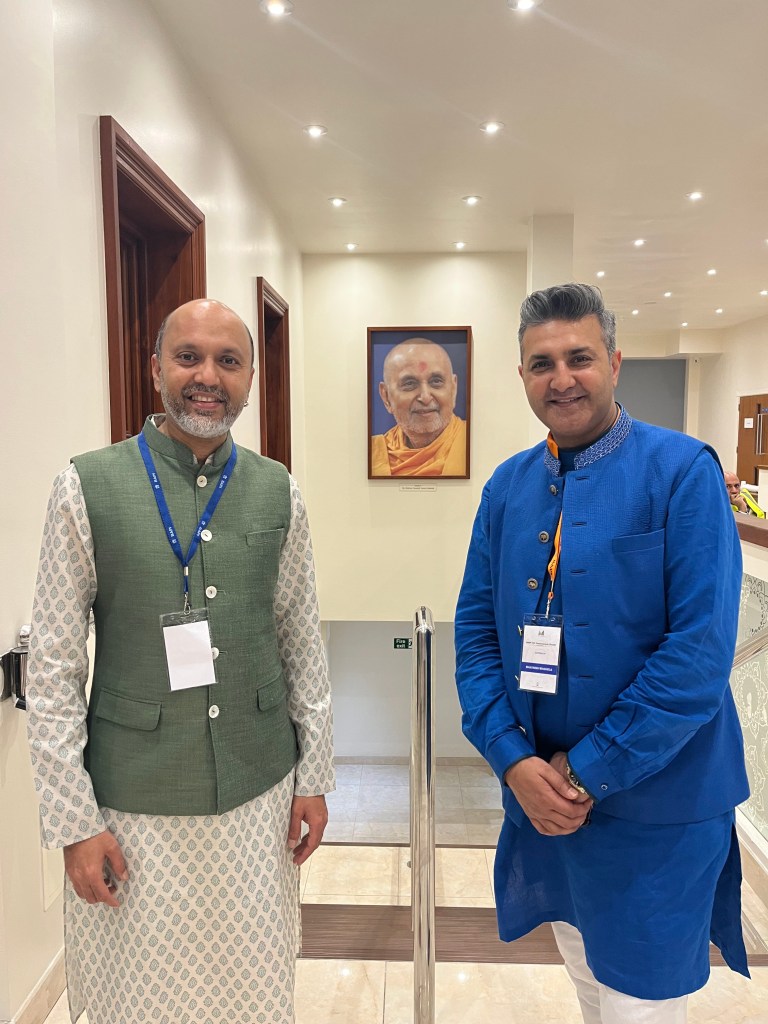
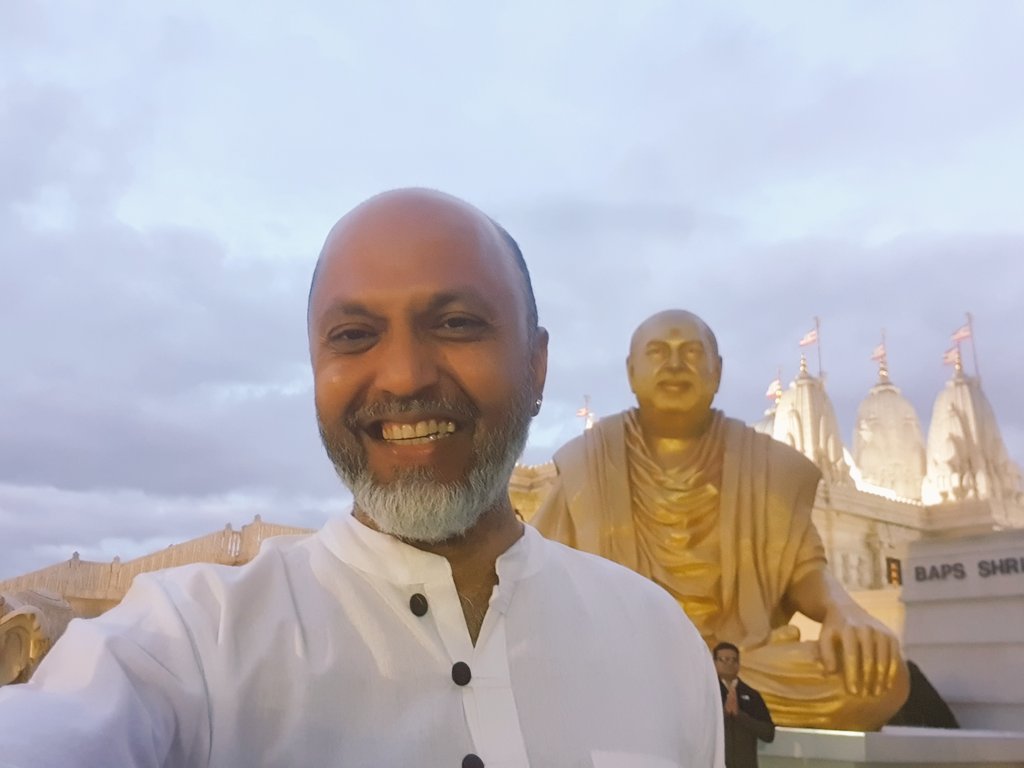
I have had the opportunity to attend the local Leicester Swāminārayan mandir, where I have made excellent friends who have become family. I have seen firsthand the incredible work they do for the organisation and society.
I have attended the sabhās at the mandir and was fortunate to organise a padhrāmani with Pujya Tyāgratna Swāmi and Pujya Paramsetu Swāmi from the Leicester BAPS mandir to bless our home. I have attended the Oadby, Leicester Parā Sabhā and seen how these sabhās empower local citizens in overcoming challenges. I had the opportunity to speak at one such Parā Sabhā and would gladly share my experiences in my upcoming write-up.
I have heard some incredible stories, and the work that BAPS did during the Covid pandemic was commendable. Way back in 2001, when a big earthquake struck Bhuj (Gujarat, India) and thousands died, BAPS remained at the forefront of helping those in need, and the organisation and its workforce assisted in reconstructing the communities from the ground up.
There is always another side to the story, and as a writer, it is critical that all aspects of the article be debated and discussed. There have been times in history where overinvestment in religious constructions, such as temples, mosques, and cathedrals, has put immense economic strain on kingdoms, potentially contributing to the downfall of mighty kingdoms.
For example, the Khmer Empire, located in modern-day Cambodia, is well-known for its spectacular religious architecture, particularly the Angkor Wat temple complex. While these structures represented the empire’s might and religious passion, the massive resources necessary for their construction and maintenance may have stressed the empire’s economy. Furthermore, the emphasis on massive architectural projects may have diverted resources away from more important parts of governance and warfare, potentially leading to the empire’s demise. India’s Taj Mahal also has a similar story.
I believe BAPS is living its vision, “BAPS Swaminarayan Sanstha is a spiritual, volunteer-driven fellowship dedicated to improving society through individual growth by fostering the Hindu values of faith, service and global harmony“9.
Before departing his mortal body, Swāminārāyan Bhagwān revealed that he would be present on mother Earth in the form of Akshar, the guru10. APJ Kalam, former President of India and a devout believer of Islam, stated in his book Transcendence that if we wish to get the darshan of sākshāt brahma, the ultimate truth, the guru at the head of BAPS is the one to see11.
As a reader of this article, what are your thoughts on BAPS’ general social work? Are there any positive experiences you’d like to share so that others can benefit from them?
What are your thoughts on the Mandir construction approach/strategy, the financial toll it may take on its followers, and the cost vs. benefit to the society as a whole? Is this sustainable and worthwhile?
Please share your thoughts in the comment / feedback section.
Jai Swaminārāyan 🙏
Photo Gallery – BAPS Family




References
- Swami Brahmaviharidas Ji On Making History With First Hindu Temple In Middle East, https://www.youtube.com/watch?v=2hmYr36UlYM ↩︎
- https://www.baps.org/Spiritual-Living/Hindu-Practices/Satsang-Sabha-and-Personal-Satsang.aspx ↩︎
- https://kids.baps.org/ ↩︎
- An example of youth development from BAPS North America , https://na.baps.org/learn/our-values/youth-development ↩︎
- https://www.baps.org/Spiritual-Living/Hindu-Practices/Satsang-Sabha-and-Personal-Satsang/Satsang-Sabha-for-Your-Family-/Ghar-Sabha.aspx ↩︎
- https://www.baps.org/About-BAPS/WhoWeAre.aspx ↩︎
- https://www.baps.org/About-BAPS/WhatWeDo/Mandirs%E2%80%93CenterforDevelopment.aspx ↩︎
- https://www.baps.org/PramukhSwamiMaharaj/PSM-100-Shatabadi-Mahotsav.aspx ↩︎
- BAPS vision, https://www.baps.org/About-BAPS.aspx ↩︎
- Guru mahima, https://www.baps.org/About-BAPS/TheFounder%E2%80%93BhagwanSwaminarayan/TheSpiritualLineage-TheGuruParampara.aspx ↩︎
- APJ Kalam sharing his spiritual experiences during his meeting with Pramukh Swami Maharaj, https://en.wikipedia.org/wiki/Transcendence:_My_Spiritual_Experiences_with_Pramukh_Swamiji ↩︎


 Bhavin Shukla
Leave a comment