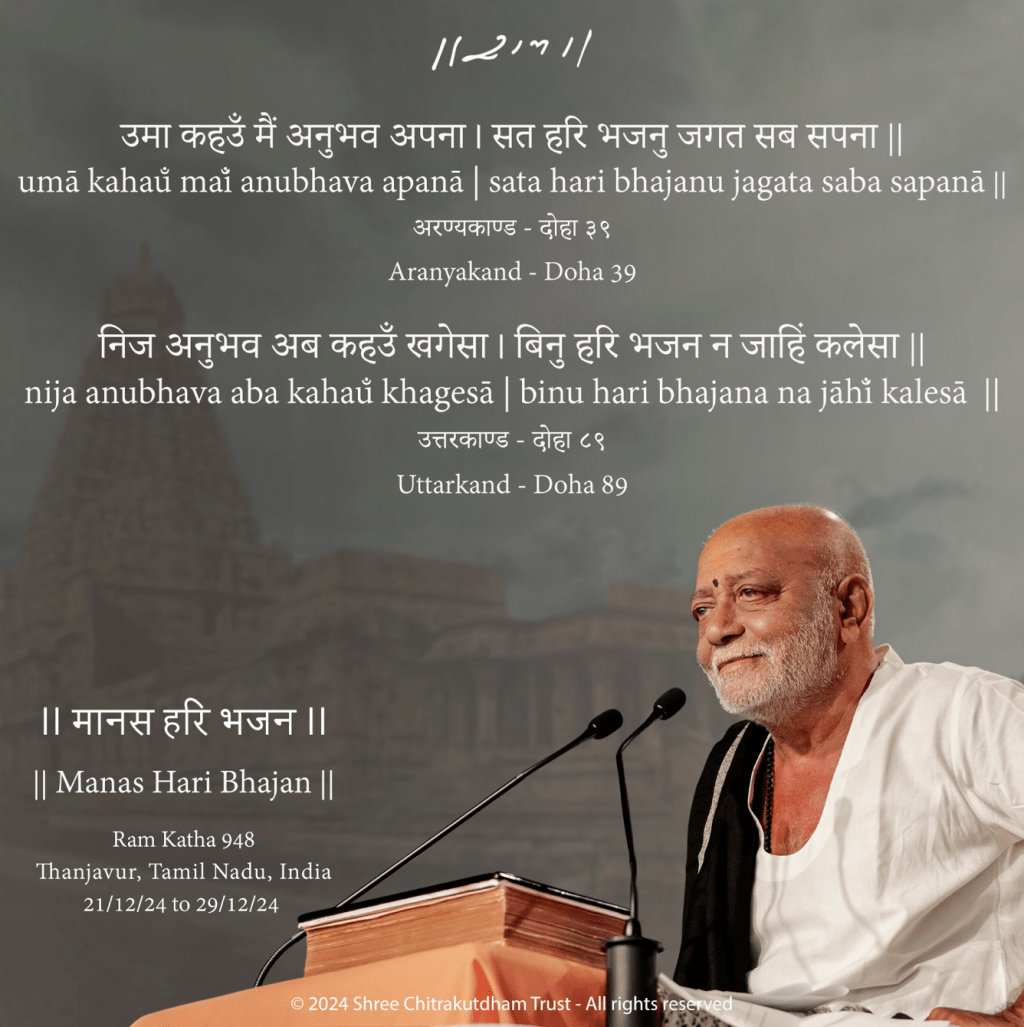
How can one attain true devotion (Bhakti)?
Sant Tulsidas Ji answers this question in Verse 204 of his work, Vinay Patrika.
जो मन लागै रामचरन अस ।
देह – गेह – सुत – बित – कलत्र महँ मगन होत बिनु जतन किये जस ॥१॥
द्वंद्वरहित , गतमान , ग्यानरत , बिषय – बिरत खटाइ नाना कस ।
सुखनिधान सुजान कोसलपति ह्वै प्रसन्न , कहु , क्यों न होंहि बस ॥२॥
सर्वभूत – हित , निर्ब्यलीक चित , भगति – प्रेम दृढ़ नेम , एकरस ।
तुलसिदास यह होइ तबहिं जब द्रवै ईस , जेहि हतो सीसदस ॥३॥
jō mana lāgai rāmacarana asa.
dēha-gēha-suta-bita-kalatra maham̐ magana hōta binu jatana kiyē jasa. (1).
dvandvarahita, gatamāna, gyānarata, biṣaya-birata khaṭā’i nānā kasa.
sukhanidhāna sujāna kōsalapati hvai prasanna, kahu, kyōṁ na hōnhi basa. (2).
sarvabhūta-hita, nibryalīka cita, bhagati-prēma dṛṛha nēma, ēkarasa.
tulasīdāsa yaha hō’i tabahiṁ jaba dravai īsa, jēhi hatō sīsadasa. (3).
Tulsidas Ji guides us on the path to devotion toward the Lord, Shri Hari. He emphasises that one’s devotion should be as natural and subtle as the effortless attachment people have toward their own well-being (appearance), homes, children, wealth, and opposite genders or life partners.
If one can effortlessly surrender their mind at the feet of Shri Hari, they can transcend the struggles and tensions of life caused by attachments to likes and dislikes, as well as the duality of joy and sorrow. This leads to liberation from ego, progress toward true knowledge, and detachment from materialism—much like a person losing interest in sour food that has turned bitter due to being stored in a vessel made of a copper alloy.
Tulsidas Ji further explains that Lord Rama, Shri Hari, is full of joy and will shower His love on such a devotee, taking care of all their needs.
As a result, the devotee will develop a mindset focused on the well-being of all, and will be free from conditioning and biases. They will fully surrender to the Lord and maintain discipline by following a daily routine of prayers while pursuing their passion.
Tulsidas Ji reflects that this transformation is only possible when Shri Hari, the slayer of the ten-headed demon, showers His mercy upon the being.
Here, Tulsidas Ji hints that the ten-headed demon is the most formidable obstacle and will primarily stand in the way of devotion (Bhakti).
The ten headed demon represents –Kāma (Lust), Krodha (Anger), Lobha (Greed), Mada (Pride), Matsarya (Jealousy), Moha (Delusion or Attachment), Mānas (Mind), Buddhi (Intellect), Chitta (Will or Consciousness) and Ahamkāra (Ego).
Thus, Tulsidas Ji resolves to surrender to Lord Rama, as this will help overcome the Ravana, the ten-headed demon, within oneself.
Pujya Morāri bāpu aka Bāpu, a well-known spiritual saint from western part of India (Gujarat), has been reciting Rām kathā, a spiritual gathering to tell story of Lord Rāma, for almost 6 decades. His method of providing spiritual discourse is unique and resonates strongly with the youth, and the current generation. Bāpu chooses a subject or theme for the nine-day spiritual discourse/talk.
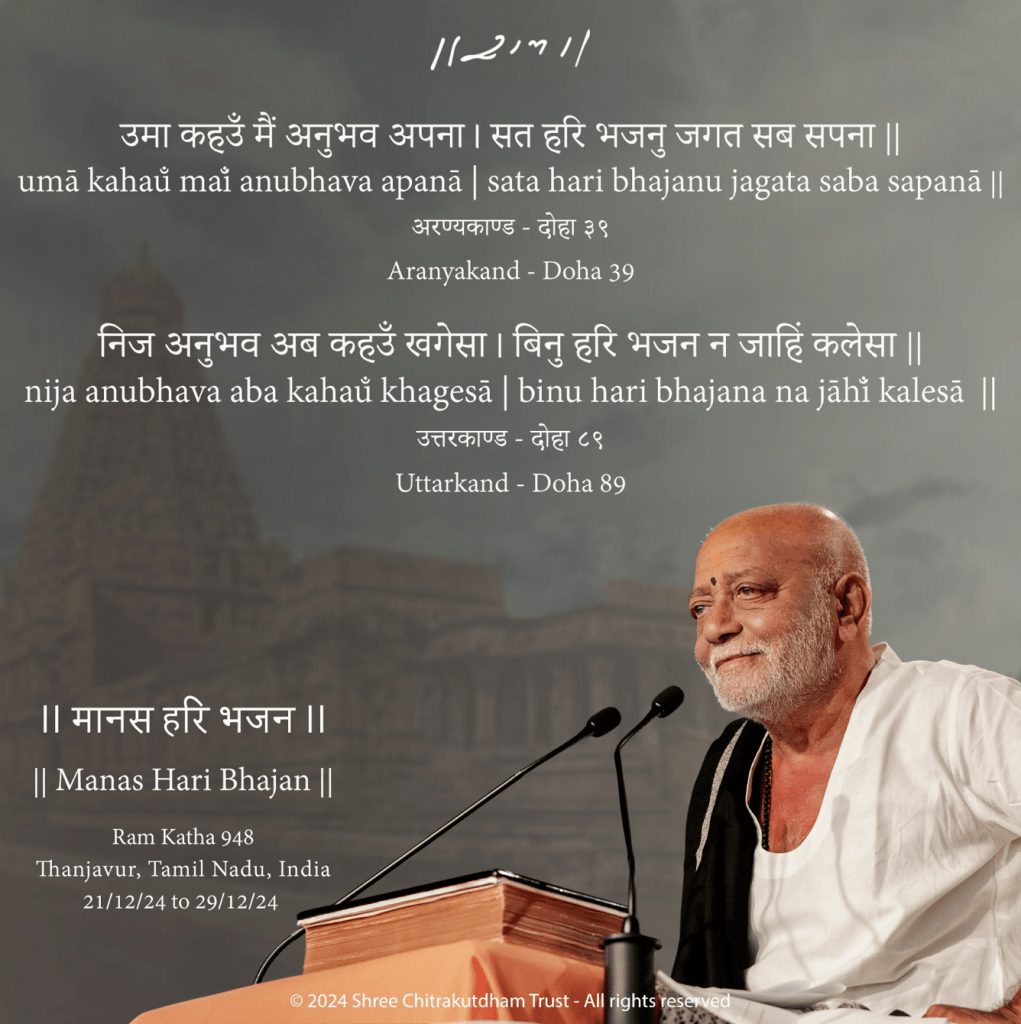
Pujya Morāri Bapu, in his recently concluded Ram Katha Mānas Hari Bhajan held at Thanjavur, Tamil Nadu, India, chose to speak on the subject of Bhajan (devotion) and selected the previously discussed pad/verse from Vinay Patrika to explain how one can get stronger in their Bhakti (devotion) and in their Bhajan.
Today is the festival of Mahāshivrātri, celebrating the divine marriage of Lord Shiva and Mātā Pārvati. This sacred day also reminds us to rise above ignorance and move toward knowledge and enlightenment. Additionally, today marks Bāpu’s birthday.
May Shri Thakorji give a long and healthy life to Bāpu, because we need to learn a lot from Him and gain knowledge from His teachings.
Pujya Bāpu, wishing you a very happy birthday, “amārā saunā pranām swikārjo, ne sau nu bhalu karjo”.
This is the first write-up on Mānas Hari Bhajan. I will continue to share more excerpts from the Rām Kathā, helping me remember and recall them in the future.
Jai Siyā Rām


 Bhavin Shukla
Leave a comment