How can one assess the quality of their own bhajan (devotion)?
Introduction: Pujya Morāri Bāpu
Pujya Morāri bāpu aka Bāpu, a well-known spiritual saint from western part of India (Gujarat), has been reciting Rām kathā, a spiritual gathering to tell story of Lord Rāma, for almost 6 decades. His method of providing spiritual discourse is unique and resonates strongly with the youth, and the current generation. Bāpu chooses a subject or theme for the nine-day spiritual discourse/talk.
Rām Kathā: Mānas Hari Bhajan, Thanjavur, Tamil Nadu
Pujya Morāri Bāpu, in his recently concluded Ram Katha Mānas Hari Bhajan held at Thanjavur, Tamil Nadu, India, chose to speak on the subject of Bhajan (devotion).
Bāpu’s Response to the Question
Bapu pointed to a pad/verse (#205) from the book Vinay Patrika, written by Sant Tulsidas Ji, to explain the impact of bhajan (devotion) in one’s life.
Whilst Tulsidas ji says that one can only be in pure devotion by doing the following, Bapu looks the same thing from a different perspective. Bapu says that if one wants to know whether he/she is truly walking on a path of real devotion then they can use this pad to measure.
#205 Jo Man Bhaj-yo Cha-Hai Hari
Shlok 1:
जो मन भज्यो चहै हरि-सुरतरु।
तौ तज बिषय-बिकार, सार भज, अजहुँ जो मैं कहाँ सोइ करु॥
Jo man bhaj-yo cha-hai Hari-su-ra-ta-ru.
Tau taj vi-shay-bi-kār, sāra bhaj, ajahun jo main kahān so-i karu.
Shlok 2:
सम, संतोष, बिचार बिमल अति,
सतसंगति, ये चारि दृढ़ करि धरु।
काम-क्रोध अरु लोभ-मोह-मद,
राग-द्वेष निसेष करि परिहरु॥
Sam, san-tosh, vi-chār bi-mal a-ti,
Sat-sang-a-ti, ye chā-ri dridh kari dha-ru.
Kām-krodh a-ru lobh-mo-h-mad,
Rāg-dwesh ni-sesh kari pari-haru.
Shlok 3:
श्रवण कथा, मुख नाम, हृदय हरि,
सिर प्रनाम, सेवा कर अनुसरु।
नयननि निरखि कृपा-समुद्र हरि
अग-जग-रूप भूप सीताबरु॥
Shravaṇ ka-thā, mukh nām, hri-day Hari,
Sir pra-nām, se-vā kar anu-sa-ru.
Na-yā-na-ni nir-khi kri-pā-samudra Hari
Ag-jag-rūp bhūp Si-ta-ba-ru.
Shlok 4:
इहै भगति, बैराग्य-ग्यान यह,
हरि-तोषन यह सुभ ब्रत आचरु।
तुलसिदास सिव-मत मारग यहि
चलत सदा सपनेहुँ नाहिंन डरु॥
I-hai bhakti, vai-rāg-ya-gyān yah,
Hari-to-shan yah subh brat ā-charu.
Tul-si-dās Shiv-mat mārg ya-hi
Cha-lat sa-dā sap-ne-hu nā-hin da-ru.
Meaning
As explained by Pujya Bapu in the katha, Sant Tulsidas Ji guides us on the path to devotion toward the Lord, Shri Hari. Sant Tulsidas ji says in this pad (verse), that if one wants to be in sublime devotion then he/she has to focus the mind on Shri Hari.
To be in devotion, one has to avoid wordly materialist pleasures, live ethically and focus on the “essense” of Shri Hari, which is Rām Nām, i.e. the name of lord Rām.
Bapu explained that lord Rām is the chitta (memory) of the world, but lord Rām’s name is the chitta of lord Rām. Chitta is one of the layers of the seven layers of existence i.e. Mind (mann), Breath (prānā), Body (kāyā), Intellect (buddhi), Memory (chitta), Ego (ahankar) and Self (atmā).
It is important for the person in devotion to see everyone as equal without any biases (सम / sam), the person should be content (संतोष / santosh) by not having complaints, likes or dislikes, one should be free from any malicious thoughts (निर्मल विचार / nirmal vichār), one should not think or speak bad about anyone or anything, and the person should be in the company of good people (सतसंगति / satsangati).
Sant Tulsidas Ji further explains that the person should completely get rid of the vices such as Kāma (lust), Krodha (anger), Lobha (greed), Mada (pride), Moha (Delusion or Attachment) and Dwesh (hatred), because these can become an obstacle in taking this journey to devotion.
Sant Tulsidas Ji shows us the path on how to overcome the obstacles. When one regularly listens to the Rām kathā (spiritual discourse on lord Rām), recites/chants lord’s name (Rām nām japa) by keeping Shri Hari in his/her heart, and who always respect others, and is eager to do sevā (service), can see Shri Hari, who is the embodiment of love and mercy, with his/her own eyes.
Sant Tulsidas Ji says, this is what it means by bhakti (devotion), and is the only tool to help liberate us from the three miseries, the physical, the mental and societal.
If one wants to please Shri Hari then one has to follow this path. The lord will get pleased because of the devotion and will grant all the wishes come true.
Finally Sant Tulsidas ji says that, this is not his advice but it is the path shown by lord Mahadev (Shiva). The one who takes this path will never have fear in their heart, not even in their dreams. Sant Tulsidas ji hints that this type of devotion will help one to fully surrender to the lord and will not have to live in doubts or worry about anything, because the lord, Shri Hari, will take care of all the needs.
Pujya Bapu says, the above is the prabhav (postive impact) of the bhajan. If one wants to know how good they are in their bhajan then they can use the above metrices to measure themselves.
Pujya Bapu also emphasises that the real test comes when the circumstances are in our favour, making it easy to blame others. Lord Ram serves as a remarkable example. When everyone was accusing Kaikeyi for Shri Ram’s vanvaas, He clarified that everything occurred due to His own actions and that Mata Kaikeyi was not to blame.
Bapu explained that this is a wonderful example of non-malicious thoughts (निर्मल विचार / nirmal vichār). Lord Rām explains that he went to the forest (vanvaas) for 14 years to churn the ocean (samudra manthan) of Bharat, his brother, in order to obtain the nectar (amrit) represented by Bharat’s love. In this process, I merely played the role of the tortoise that supported the mountain used to churn the ocean.
What we need is the patience (dhiraj) to suppress our anger when it is tempting to raise our voices, especially when we see that we are having an upper hand and the other person is in a vulnerable situation, which can only come via the power of Bhajan.
When we can exercise self-control and steer clear of negative emotions in situations that work to our advantage, it truly shows the depth of the bhajan one follows.

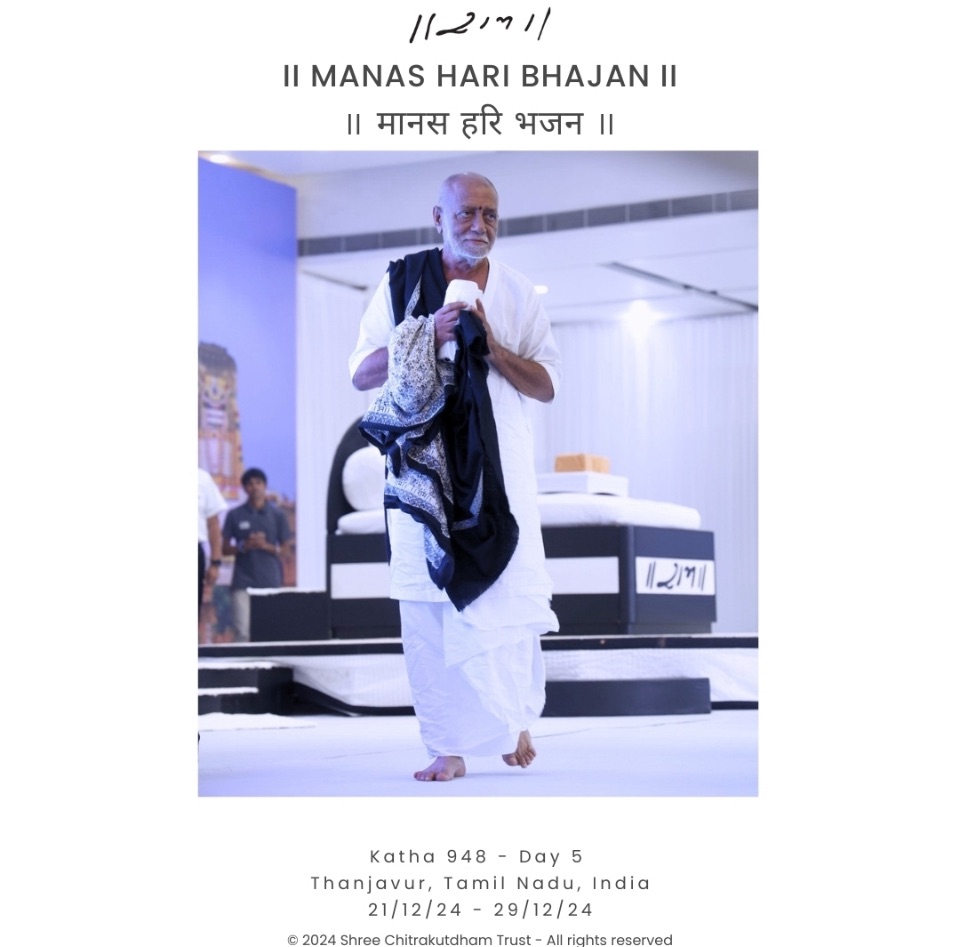

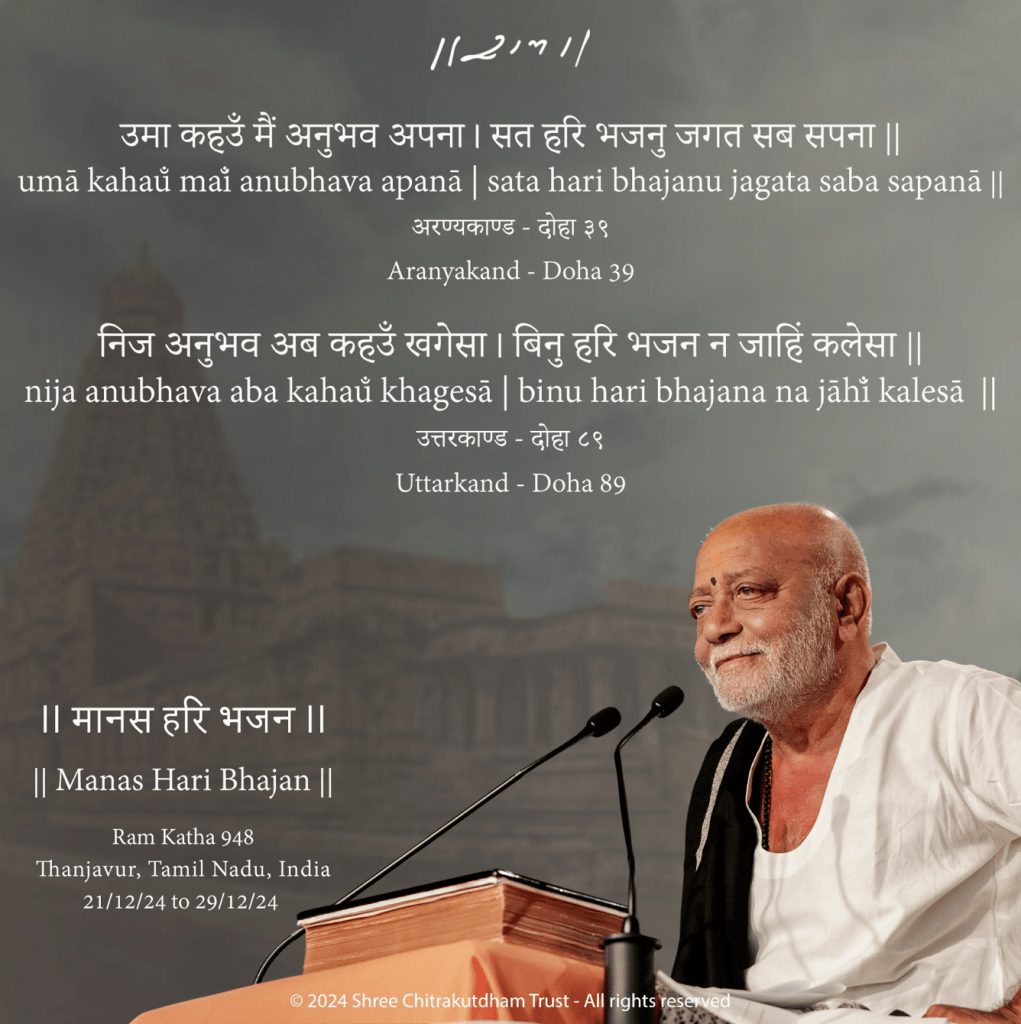
This write-up is from Day 2 of the Mānas Hari Bhajan katha. Even while watching it on YouTube, I have personally felt that the energy of this katha is quite distinct from other Ram kathas I have listened to, and it is likely to remain one of my all-time favourites 😇 What’s your view, have you listened to this katha? I would love to know your experiences.
I will continue to share more excerpts from the Rām Kathā, helping me remember and recall them in the future.
Jai Siyā Rām 🌸🌺


 Bhavin Shukla
Leave a comment