Sunita (Sunny) was a bright student academically and ended up studying at one of the best universities in Mumbai, India. The challenges she faced due to her humble background, being a woman, and coming from a small city, never pulled her back, which was mainly due to her hard work and ethics towards achieving something she wanted to, but in the right way.
Because of her high-flying profile and strong recommendations from the professors of her institute, after her undergraduate course, she managed to secure admission in one of the most prestigious universities in the UK.
She then got a job that suited her interests in one of the top multinational companies, where she met William (Will), who had a different background and upbringing, but his academic and career growth were similar to Sunita’s. They both got married and started their family life in London.
Time flew, and they had three children, the eldest was now in the university studying law, the middle one was writing A Levels, and the younger one was writing GCSE. They all were bright academically, too, and it was obvious that they, as well, would have a great career ahead. Sunny and Will built a perfect, happy family!
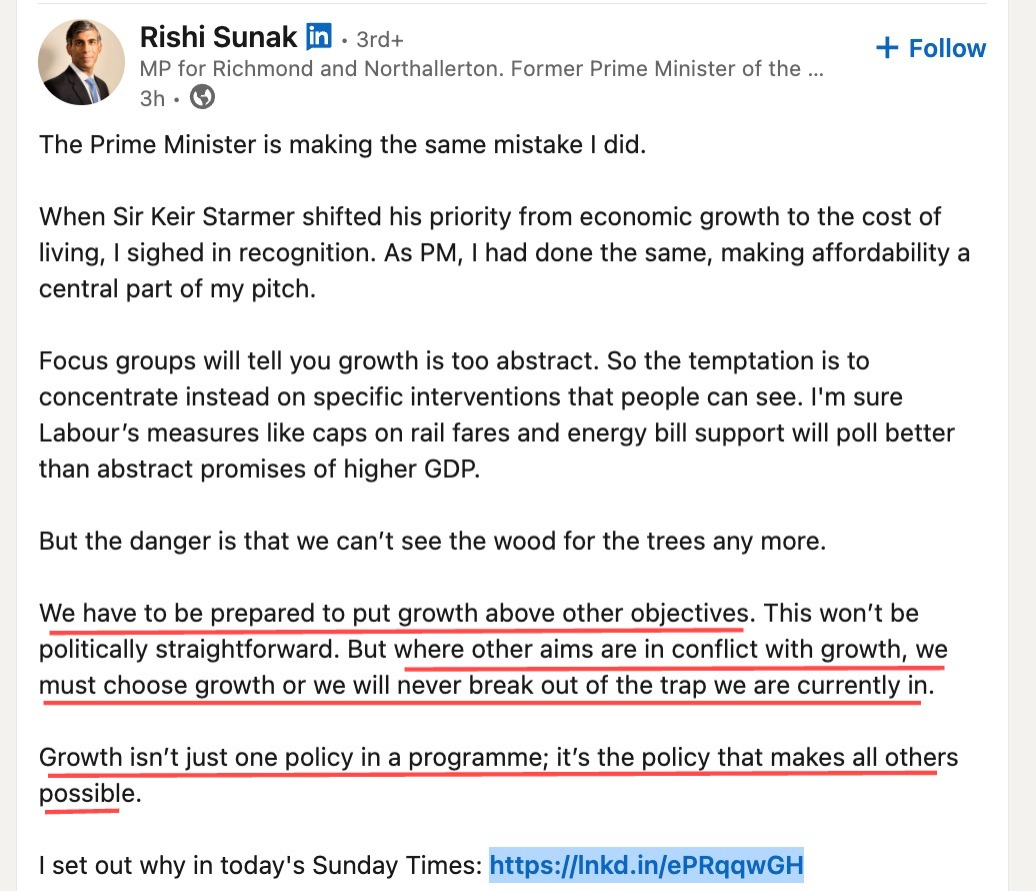
It was a Saturday morning and family breakfast time, and Will saw a public post on LinkedIn from Rishi Sunak, Britain’s ex-PM, to Sir Keir Starmer, the current PM, on the mistakes Rishi made during his term as a PM, advising that longer-term economic growth is the right strategy.
This was the start of the discussion.
Will: Sunny, I’ve been saying this all along, economic growth should be the strategy, and all the national policies should be aligned to this.
Sunny: Yes, that’s true, but what does that mean to us, and why are we discussing this at the breakfast table?
Will: I think we too need to follow the same strategy at the family level. We need to align ourselves and prioritise economic growth above everything. What do you think?
Sunny: I don’t think so! How we execute plans at the national level vs. how we run families are two different things.
Will: Hmm.
Sunny: What about the other dimensions of life, i.e. cognitive/educational growth, moral/ethical growth, social growth, health/physical growth, emotional growth, spiritual growth, etc.?
She further added,
Focusing solely on economic growth to achieve financial independence might be too one-dimensional.
Many people grow in one area and suffer in other areas:
- Financial ↑, health ↓, relationships ↓
- Education ↑, morality ↓ (clever self-justification)
- Social ↑, inner life ↓ (if society loves it, then the path/purpose is definitely right – everything is socially vetted/approved, so it is believed to be good, making one blindsided.)
Will: Indeed. The role of the family is to produce good citizens, and the role of the government is to run the nation with the help of good citizens. If families fail to raise good citizens, then the government will need to divert its important resources to address societal issues, impacting its strategy.
This was all getting interesting for a Saturday morning, and now the kids jumped in to understand it a bit more.
Children: Economic growth is measurable and quantifiable, but who decides what is right or wrong for the other dimensions?
Dad: The cultural aspect defines it. Let’s describe what Physical Growth mean to society.
Health / Physical Growth:
What is it: Increase in energy, resilience, and longevity.
Why it matters: without this, one may be constrained to enjoy the benefit of other growths.
Growth Indicator: the body helps one live the life one wants to, instead of limiting it.
Children: That’s correct, but still, this one can be easily observed and felt through. What about the other ones?
Mom: Let’s pick up each one of them, say, emotional growth:
Emotional Growth:
What is it: the ability to work in the range of the emotional spectrum of being extremely happy to events leading to extreme grief.
Why it matters: without this, one may not be able to use intelligence, morality and relationships well.
Growth Indicator: hard moments can pass through you instead of defining you.
Why do we need to grow morally and ethically? because…
Moral / Ethical Growth:
What is it: We need to align actions to our beliefs.
Why it matters: Preaching one thing and then practising another is hypocrisy, and hypocrisy can make one feel hollow inside.
Growth Indicator: Increase in self-respect. One respects oneself more and more with time.
Children: Yes, we get it. Thank you. So growing into finance would be to get financially independent?
Dad: That is only partially true. Financial growth does not mean having enough money in the bank that provides stability in life. Remember, money is a tool (means), not the goal (ends). What’s the point in acquiring a tool if we don’t know how to use it?
So I would define Financial Growth as something that creates life options.
Financial Growth:
What is it: An increase in the number of options to choose, not just an increase in income.
Why it matters: It helps improve lifestyle, and money can aid in skill improvement.
Growth Indicator: Money creates choices, not pressure.
Mom: Brilliant, thank you, I have not heard a better and clearer definition of what financial growth actually means. We can now link the Ethical Growth to the Financial Growth. M K Gandhi used to say that ends and means are inseparable, “as the means, so the end.” If we choose to take shortcuts in life to earn money, then the money used in any activity will give a suboptimal output. Gandhiji hence chose non-violence as a tool for the freedom movement, which was to build a better nation post-independence.
Children: What about the Social Growth? What does that mean, and do we measure it?
Dad: This is super important in the times we live. So many people are going through mental health problems because of the lack of their social growth and connection to society, and society’s unwillingness to help support individuals to grow in this area.
Social Growth:
What is it: Improving the quality and function of the relationships.
Why it matters: Humans are social animals, and being with others helps regulate stress. Without celebrations with others, the other growths can seem dull.
Growth Indicator: Less lonely, the size of the group and/or how many people you know doesn’t matter.
We can see around how the relationships are breaking within the families, between friends, between colleagues within organisations, how politicians are dealing with ministers of other parties, and how the insults are taking place at the global level. This is all related to a lack of focus and investment in Social Growth!
As your mom always says, vasudhaiva kuṭumbakam, i.e. the world is one big family. We need to treat everyone equally as if they are part of our own family.
Mom: Yes, this verse is from the ancient Hindu scriptures called the Mahā Upnishad:
Ayaṁ nijaḥ paro veti gaṇanā laghu-cetasām; udāra-caritānāṁ tu vasudhaiva kuṭumbakam.
Meaning: This is my own relative, and that is a stranger – is the calculation of the narrow-minded. For the magnanimous-hearted, the entire world is a family.
Children: Thank you, but how does Spiritual Growth have to do with this all? Should we pray to Krishna more than Jesus or vice versa to help grow faster?
Mom: Spirituality is not about religion. We are pieces of a big puzzle. We all have a specific place/position to fit into to complete the puzzle. Spirituality is about finding where we fit in the bigger picture, i.e. finding “who we are” – finding your trueself! It’s not about God or religion. I think we have discussed this once, here: What is Spirituality?
Spiritual Growth:
What is it: giving life its meaning and purpose, finding “who am I.”
Why it matters: it gives you the north star and gives clarity on why we are doing what we are doing, and what for.
Growth Indicator: the outcomes do not matter anymore, as one is more stable and anchored even when things go the other way.
Children: But how would one find life’s meaning and purpose? Wow, that’s deep! Everyone at the table started laughing 🙂
Dad: There is no defined way. You need to find your own path to find your real identity. If you choose to follow someone, then that will lead to their purpose, not yours!
But you can get some help by looking around at how various people, communities and cultures have tried to do this. Maybe you can try that someday.
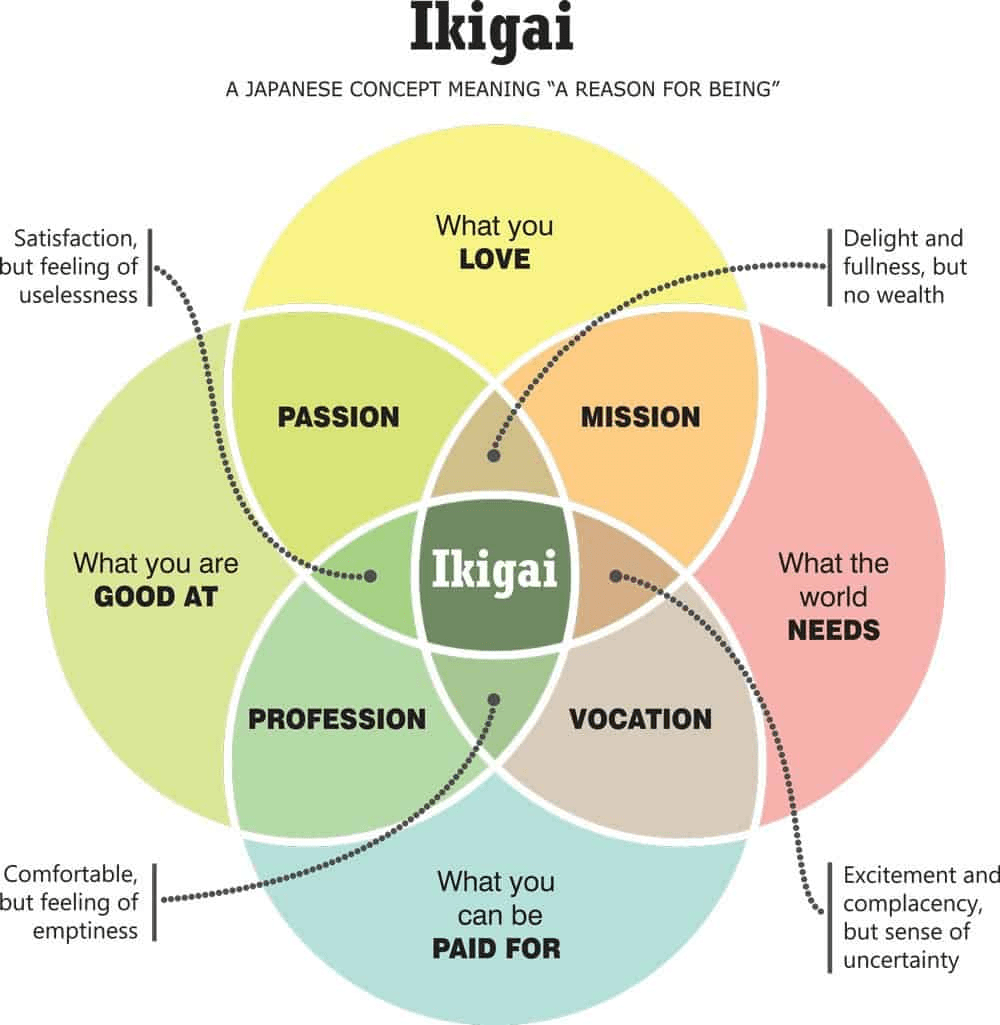
As an example, Ikigai, a Japanese concept, means “a reason for being”. The book Ikigai explains this further in detail, here. It gives a good framework on how to find these answers. It also connects our discussion on growth, that if you grow in one area at the expense of others, then what you feel you missed out on, having “fomo” as you guys say it. 😄
Children: Mom and Dad always do this to us. They take us to a point and then leave us to find answers, so annoying! 😖
Mom: Good discussion, all. Let’s end here and get ready, we are getting late for swimming 🙂

 Bhavin Shukla
Leave a reply to chandraas980c18c83f Cancel reply