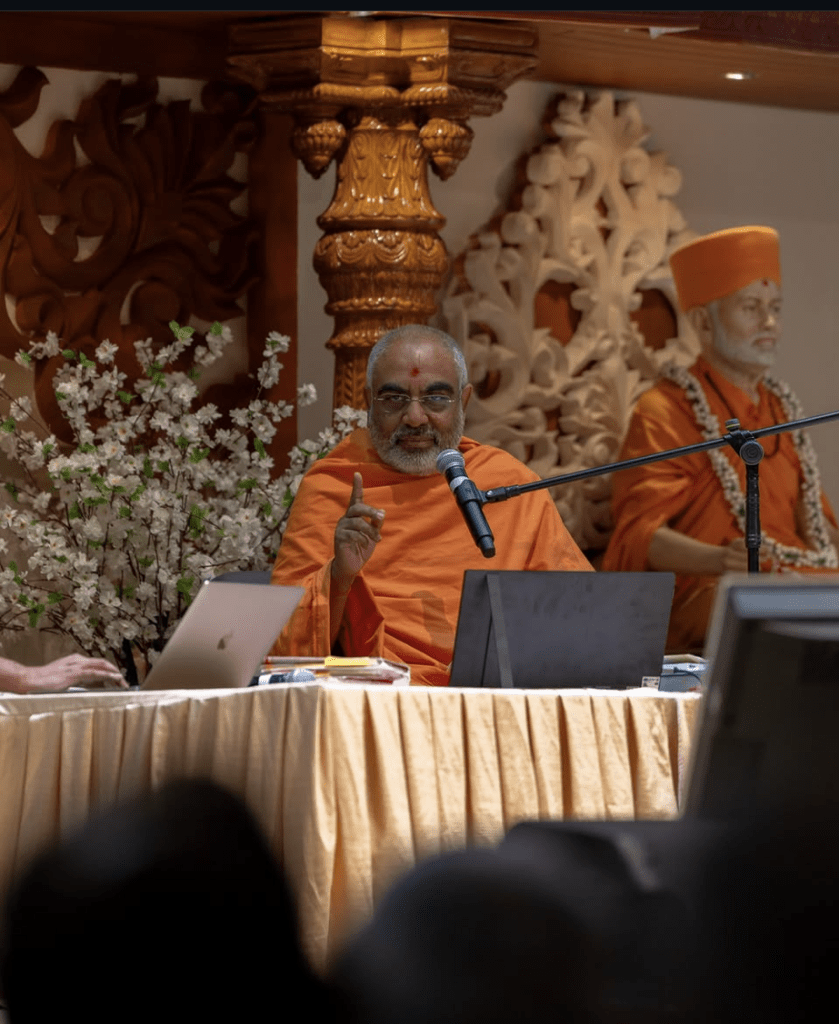
I recently attended a lecture by Pujya Yogvivek Swami in the BAPS Swāminārayan sampradāya (sect), and one of the themes that stood out most clearly was the meaning of upāsanā1. The discussion was enlightening, but what made it especially helpful was how it connected philosophy, devotion and practical spirituality in a very direct way.
At the heart of the talk was a simple but profound message: become Akshar roop (Aksharrup2) and offer upāsanā to Purushottam.
Indian Schools of Philosophy
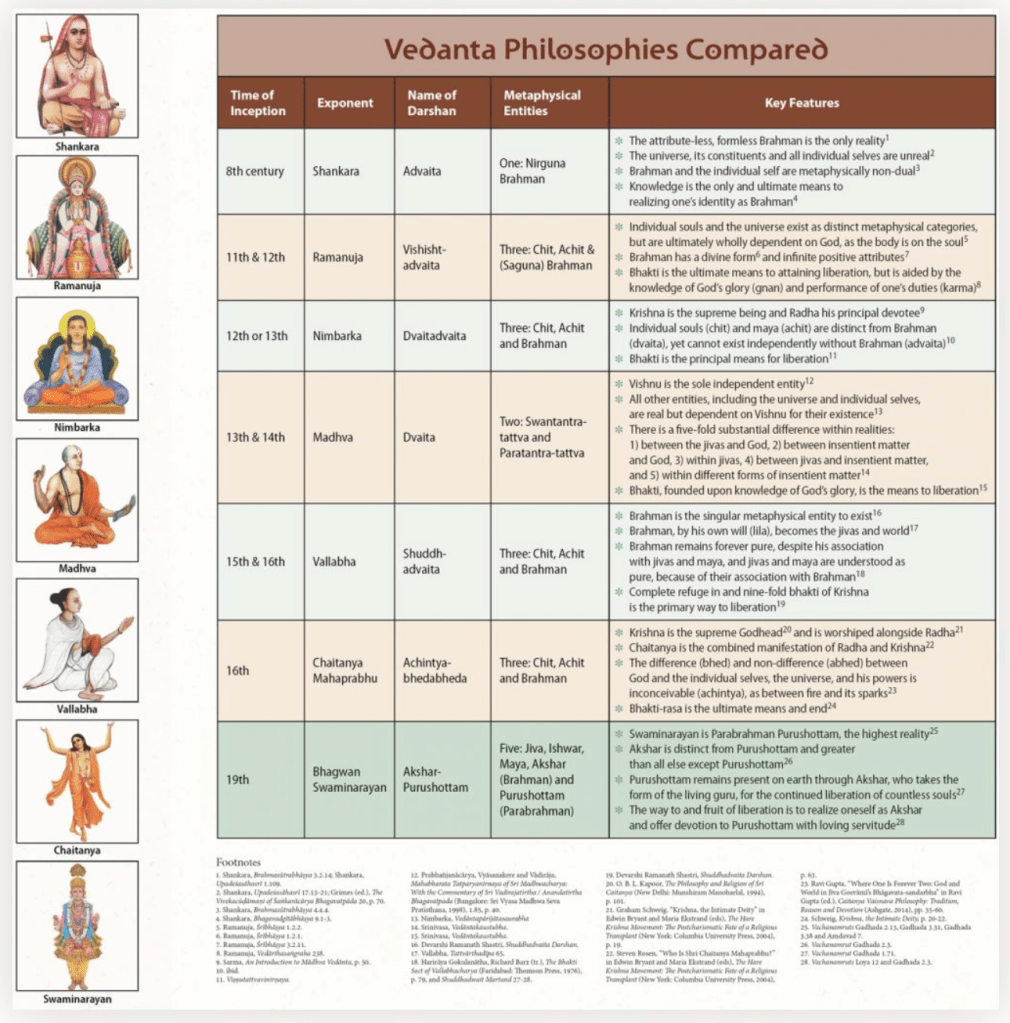
Indian schools of philosophy is also known as Darshan or Darshan Shāstra. It should be noted that the scholars during their research, established Swāminārāyan darshan different from the others; It is close to vishishtadvaita but it has its own darshan called, Akshar Purushottam darshan3.
What is upāsanā?
The lecture explained upāsanā as more than just worship in the ordinary sense. It was described as dridh aashray – having firm refuge in God – and also simply as bhakti. That immediately gives it a deeper and more personal meaning. Upasana is not only about ritual or outward practice, it is about where one places one’s trust, loyalty and devotion.
Another helpful explanation was that upāsanā means “sitting near”. I found that especially relevant because it suggests closeness – not only to knowledge, but to one who truly knows and lives spiritual truth.
Swāmi also made an important distinction: upāsanā is not the same as “ātma nishtthā” in the Advaita sense of aham brahmasmi. In this context, it is not about identifying oneself as the absolute. Rather, it is about devotion towards one’s Ishta Dev – the God one believes in and follows.
Why upāsanā matters
One of the important points made in the lecture was that without upāsanā, it is not possible truly to realise the ātma and Para-Brahm. In other words, upāsanā is not an optional extra in spiritual life, it is essential.
This was connected with the idea of pativrata bhakti towards one’s Ishta Dev – a devotion that is single-minded, faithful and undivided. A person may perform seva in different ways, but upāsanā belongs only to the Ishta Dev. That clarity is important, because it keeps devotion focused.
The five tattvas in Swaminārāyan Darshan
The lecture then moved into the philosophical, or as referred in sanatan dharma – darshan side, of the tradition. According to Swaminarayan Darshan, there are five tattvas:
This fivefold understanding was presented as one of the distinctive features of the Swāminārāyan darshan (philosophy). Pujya Yogvivek Swāmi briefly compared it with other Vedantic darshans.
Pujya Yogvivek Swāmi provided references during his lecture from various shāstras, spiritual books, and the main one referred to was the Vachnāmrut.
The Vachnāmrut, a compilation of 273 spiritual discourses, is divided into 10 sections. The discourses were delivered by Bhagwan Swaminarayan in the last decade of his life, between 1819 and 1829 CE in Gujarati. They were mostly delivered in ashram-like ambience in secluded places like Gadhadā, Sārangpur, Kariyani, Loya, Panchala, Vadtal, Aslali, and Jetalpur.
The Vachnāmrut of Bhagwān Swāminārāyan is considered as the most sacred and foundational scripture of the Swāminārāyan Sampradāy.
Brahm and Parabrahm are different
One of the most important clarifications in the lecture was the distinction between Brahm and Parabrahm.
This was expressed very clearly:
- Brahm is Akshar Brahm
- Parabrahm is Purushottam
That means they are not the same reality. This matters because it shapes the entire spiritual path. The jiva does not become Parabrahm. Instead, the jiva must become like Brahm in order to offer upāsanā to Parabrahm.
This was summed up in the central phrase of the lecture:
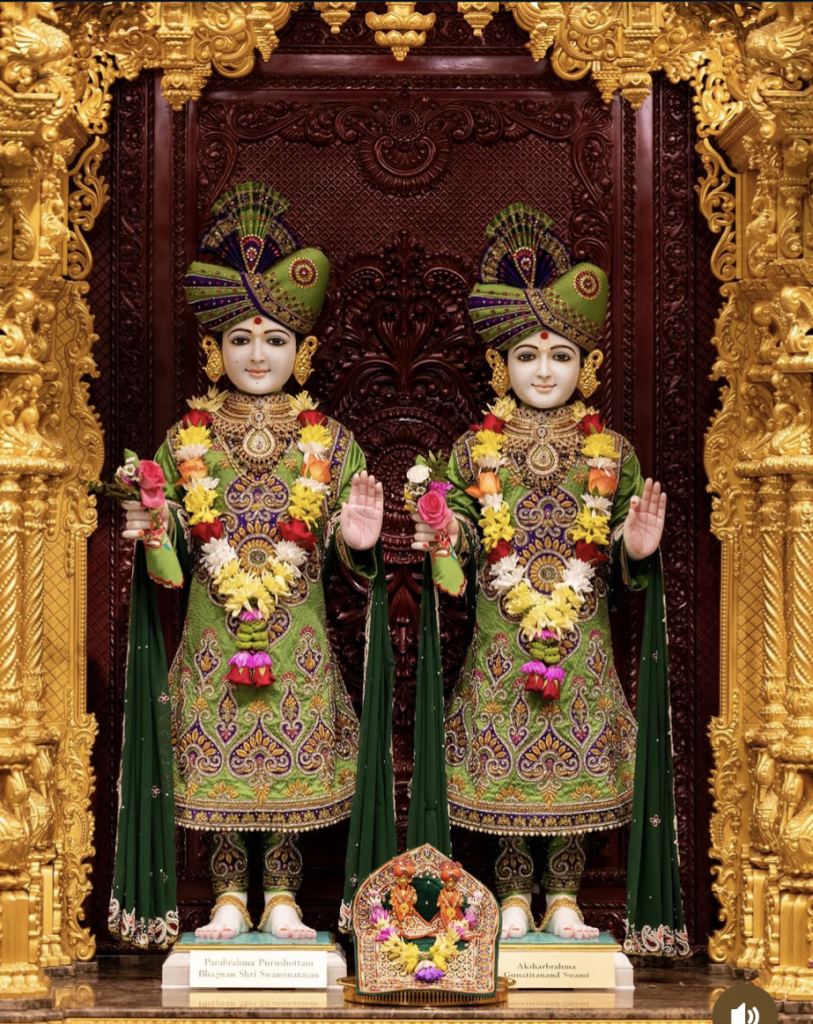
Aksharrup thai ne Purushottam ni upāsanā karvi
Become Aksharrup and worship Purushottam.
That, really, was the main takeaway.
What does it mean to become aksharrup?
A particularly thoughtful point in the lecture was that the path is not about keeping three separate categories in mind – “we as in jiva, Akshar and Purushottam”. Instead, it is transformative. One becomes like Akshar in order to worship Purushottam.
As per Pujya Yogvivek swami, this idea was also connected to Pramukh Swami Maharaj’s letter of 2008, where Swaminarayan Darshan has been clearly articulated.
The next question, naturally, is how one becomes aksharrup. Here the lecture referred to Madhya 31 of the Vachanamrut, where the principle is that through reflection and the company of Brahm, one becomes like Brahm. In simple terms, one becomes aksharrup through association.
The role of the Satpurush
This leads directly to the importance of the Satpurush. According to the lecture, spiritual liberation is not possible without the company and service of the manifest Satpurush. Pratham 54 of the Vachanamrut9 was cited to support the point that without Satpurush nu sevan, one cannot truly understand the Vachanamrut.
That gives the guru-parampara a living significance. It is not merely a historical chain of teachers, but a pragat ni parampara – a living lineage of manifest spiritual presence. The lecture also referred to Madhya 21 of the Vachanamrut10, which speaks of the importance of the company of the present Sant.
Akshar Purushottam Darshan
- Shri Swaminarayan is Parabrāhman Purushottam, the highest reality
- Akshar is distinct from Purushottam and greater than all else except Purushottam
- Purushottam remains present on earth through Akshar, who takes the form of the living guru, for the continued liberation of countless souls
- The way to and fruit of liberation is to realise oneself as Akshar and offer devotion to Purushottam with loving servitude
Why only one manifest Akshar Brahm?
Towards the end, the lecture addressed a question that often arises in the tradition: why is there only one Pragat Akshar Brahm or one true Satpurush at a time?
The explanation given was that this is part of Maharaj’s arrangement within the sampradaya. There is one manifest Akshar Brahm who is spiritually active and empowered.
The analogy used was: one car is being driven, while others are in the garage. The others may have equal potential, but only one is currently in use. In the same way, there may be others who remain in the background, but only one is the manifest form at a given time.
A wider scriptural foundation
The lecture also placed these teachings within a broader scriptural setting. It was noted that the 273 Vachanāmruts are drawn from the final ten years of Shreeji Maharaj’s discourses. Akshar is also discussed in the Upanishads and in the Bhagavad Gita, especially in Chapters 8 and 15, titled Akshar Brahm Yog and Purushottam Yog respectively.
These references show that the distinction between Akshar and Purushottam is not treated as a recent made up idea, but as something deeply rooted in scripture.
Final thoughts
What I appreciated most about this lecture was the way it brought devotion and darshan (philosophy) together.
The teaching was not presented as abstract metaphysics, or philosophy, for its own sake. It was presented as a path:
“the jiva associates with the manifest Brahm through the Satpurush, becomes aksharrup, and then offers upāsanā to Purushottam, the Ishta Dev.”
Seen in that light, the teaching is both intellectually clear and spiritually practical. It gives a framework for understanding Swaminarayan Darshan, but it also gives a direction for living it.
Jai Swāminārāyan.
Glossary and References
- Upāsanā
‘Sitting near’, derived from ‘upa’ + verb-root ‘ãs’ – meaning to sit near. Philosophical framework outlining the fundamental principles of a doctrine. Philosophical understanding of the nature of God as well as the mode of worship of God, i.e., how one understands God to be like, and how one worships Him {Gadhada I-40.6; Panchala-6.3; Gadhada III-36.6}. Sometimes synonymous with bhakti. ↩︎ - Aksharrup
1) ‘Form of Akshar’. That which has qualities similar to those of Akshar. Used to describe the spiritual state of akshar-muktas. Highest level of faith or spiritual status is to become aksharrup and worship Purushottam {Loyã-12.8}.
2) Is also sometimes used to describe things that have attained qualities similar to Akshar through his contact, e.g., light {Gadhada II.13.16}. ↩︎ - https://www.hinduismtoday.com/magazine/educational-insight-akshar-purushottam-school-of-vedanta/ ↩︎
- Jiva
1) ‘That which is living’, derived from verb-root ‘jiv’ – to live. Individual, embodied soul still bound by mãyã and consequently undergoing the cycle of births and deaths. Infinite in number. With the three bodies – sthul (gross), sukshma (subtle), and kãran (causal) – and three states – waking, dream, and deep sleep. First of the five eternal entities.
2) Often used synonymously with ãtmã, i.e., a pure soul distinct from all traces of mãyã {Panchala-3}. ↩︎ - Ishwar
Second of the five eternal entities. Infinite in number. Similar to jiva with respect to being bound by mãyã – i.e., composed of the 24 elements, having three bodies, three states, three gunas, desires, etc. – but involved in the processes and lordship of the brahmãnds, and thus endowed by God with greater powers. Brahmã, Vishnu, Shiv and all entities greater than them upwards to Prakruti-Purush, are considered ishwars. ↩︎ - Māyā
Instrument or power of God used as the fundamental ‘substance’ of creation. By nature, it is composed of the three gunas, is both jad and chaitanya, eternal, nirvishesh, and in its dormant state – before the time of creation – houses all jivas and ishwars, and all elements {Gadhada I-12.6}. It is inspired by, controlled by, and dependent on God Himself {Gadhada II-21.13}. The jivas and ishwars must transcend mãyã, i.e., eradicate it within themselves, in order to attain Akshardhãm. ↩︎ - Akshar
1) ‘Imperishable’. Second-highest of the five eternal entities; i.e., transcends everything except Purushottam. Also referred to as Aksharbrahma or Brahma.
2) In his personal form, Akshar serves Purushottam in His abode, Akshardhãm, and manifests as His ideal devotee, the Satpurush, on earth. Both forms are human in appearance.
3) In his impersonal form, Akshar is the abode of Purushottam, called Akshardhãm.
4) In his all-pervading anvay form, Akshar is called Chidãkãsh {Gadhada I-21; I-46; I-65} ↩︎ - Purshottam
‘Supreme being’, God. God, according to Shriji Mahãrãj, is: one and unparalleled, omnipotent and the all-doer, omniscient, omnipresent, the reservoir of all forms of bliss, devoid of any attributes of mãyã (i.e., divine), replete with all forms of redemptive attributes, always manifesting on Earth, and always with a human form. Also called Parabrahma or Paramãtmã. Highest of the five eternal entities – transcending even Akshar. ↩︎ - https://www.anirdesh.com/vachanamrut/index.php?format=en&vachno=187 ↩︎
- https://www.anirdesh.com/vachanamrut/index.php?format=en&vachno=154 ↩︎


Leave a Reply