It is a story of resilience, patience, hard work and determination, but more than that, it is a story of love that spans more than 75 years.
“When you truly love someone, you love everything associated with them.”
Param Pujya Mahant Swāmi Māhārāj
The Beginning
The story goes all the way back to the 1950s.
One of the well-known saints of BAPS Swāminārāyan Sanstha, Param Pujya Yogiji Māhārāj, mentioned to one of the BAPS hari bhakts (devotees) to start a congregation outside India, in London, and gather like-minded people to take teachings from Bhagwān Swāminārāyan and implement them in their lives.
The small congregation started and quickly grew in size, from single digits to tens of people. When Shri Gulzarilal Nanda, then a Union Minister of India, and who later became the Prime Minister of India, visited London in 1959, the same group organised a small event, on Pujya Yogiji’s instructions, to showcase the cultural activities by Indians outside India.
Everyone, including the High Commission of India, London, was impressed with the cultural show put on by the group.
This gave a boost to the movement, as now the event was not just discussed locally within the Indian diaspora, but in India as well.
As the satsang in London continued to grow, the need for a permanent spiritual home became clearer.
The First BAPS Mandir in Europe
Param Pujya Yogiji Māhārāj was visiting Kenya in 1970, and the Hari Bhakto in London requested Swāmi to visit London too. Pujya Swāmiji said that he would only visit if there was a mandir for Bhagwān Swāminārāyan procured. Pujya Yogiji Maharaj also put a finger on the map of London to show where the mandir would be.
The devotees started looking around. After lots of negotiations and arranging finances, they eventually bought the property, which, coincidentally, was in the same area that Param Pujya Yogiji Māhārāj had pointed to on the map.
The devotees did all this because they loved their Guru and wanted to invite Him to London. It is to be noted that this was not an individual’s effort, but a social movement that enabled the acquisition of the property.
The address of the property was 77 Elmore Street, Islington, London. This was the first BAPS temple in Europe.
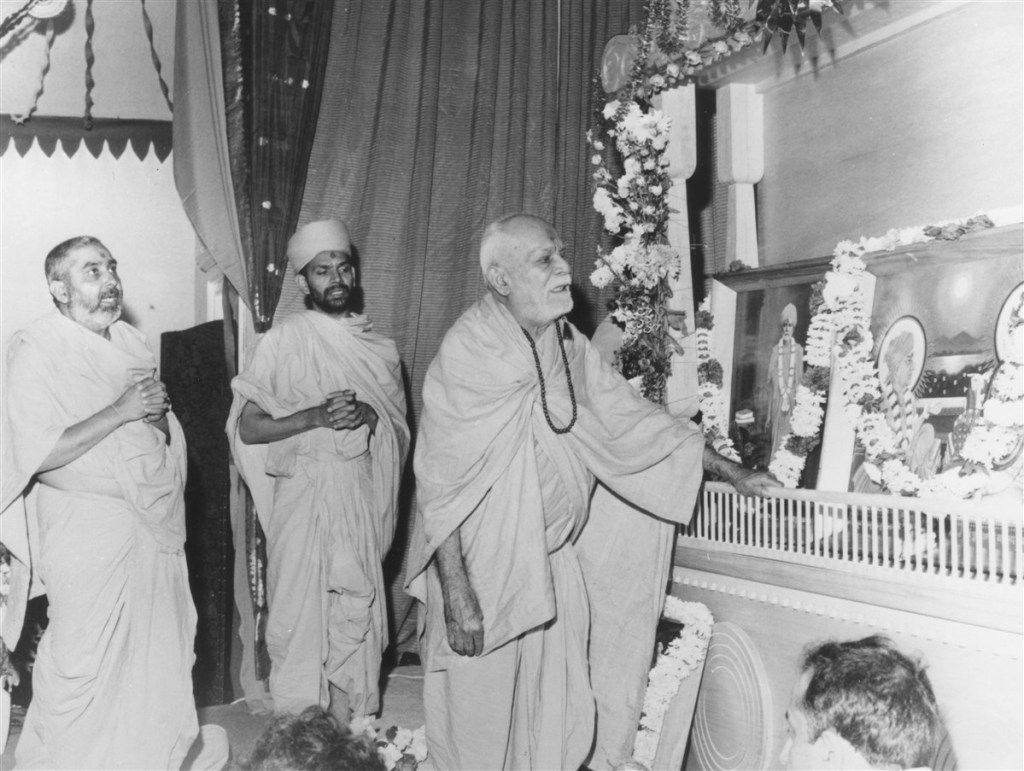
Pujya Yogiji Maharaj and the sadhus visited and stayed in the UK for six weeks and blessed the mandir by saying, “One day, this mandir will be too small to accommodate the devotees. Satsang will flourish throughout London. A great shikharbaddha mandir will be erected. Hundreds of thousands of people will benefit.“
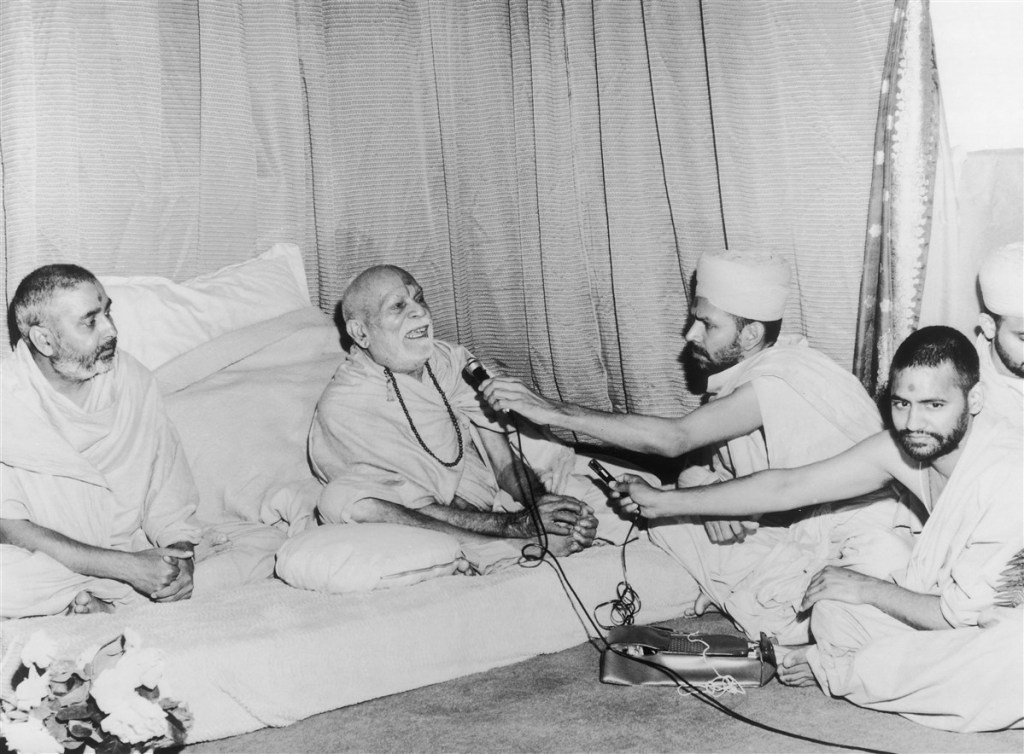
This was the only visit of Param Pujya Yogiji Māhārāj to London, as he unfortunately passed away on 23 January 1971 at the age of 78.
What began as a small mandir soon became a place of strength and belonging for many more families arriving in the UK.
A Growing Satsang and a Greater Vision
In 1972, thousands of Indians were expelled from Uganda to India. Most of the Indians were from the Gujarati community.
They all wanted a place to help them heal from what they had gone through. Islington was that place where they found peace. But now, the Islington temple could not accommodate everyone and was getting congested.
Param Pujya Pramukh Swāmi Māhārāj visited the UK a few times and opened a few temples around the UK. Finally, in 1982, as per His vision, a new temple was inaugurated at Neasden, London, but He wanted to make this a marble shikharbaddha temple as per His Guru’s wishes. The Hari Bhakto acquired more land, and finally, the construction of Neasden temple began in 1992. BAPS Shri Swaminarayan Mandir, London, was inaugurated by Param Pujya Pramukh Swāmi Māhārāj on 20 August 1995.
But while Neasden became the fulfilment of Yogiji Maharaj’s vision, the original Islington mandir continued to hold a special place in the hearts of the devotees.
What happened to the Islington Mandir?
The Islington mandir was sold around 1987. The mandir was too small to accommodate devotees, and there were some financial challenges because of which the mandir property had to be sold.
Currently, the property is occupied by the Children Houses School, which operates a nursery to 11+ private school for north London residents.
The Longing to Return
For the past 25+ years, there have been numerous efforts and requests to the owner of the property by the Hari Bhakto to re-buy the property, as for them, it is a treasure of memories they spent with their esteemed Gurus.
The Islington mandir housed so many kishores (kids) and yuvaks (youths) in those days, who are now sants (saints) working within BAPS, and they have uncountable stories associated with the mandir.
On many occasions, the sale was almost agreed, but then, at the very last minute, it was backtracked due to some challenges.
Jevā Me Nirakhyā Re
A special sabhā (congregation) was announced to be held on 30 May 2026 in the Neasden mandir, inviting the Hari Bhakto, as many esteemed swāmis / sant gaṇ were visiting London from India. Pujya Nārāyanmunidās Swāmi, Pujya Brahmvihāridās Swāmi, Pujya Rushirājdās Swāmi and Pujya Brahmacharandās Swāmi were visiting from India, hosted by Pujya Yogvivekdās Swāmi.
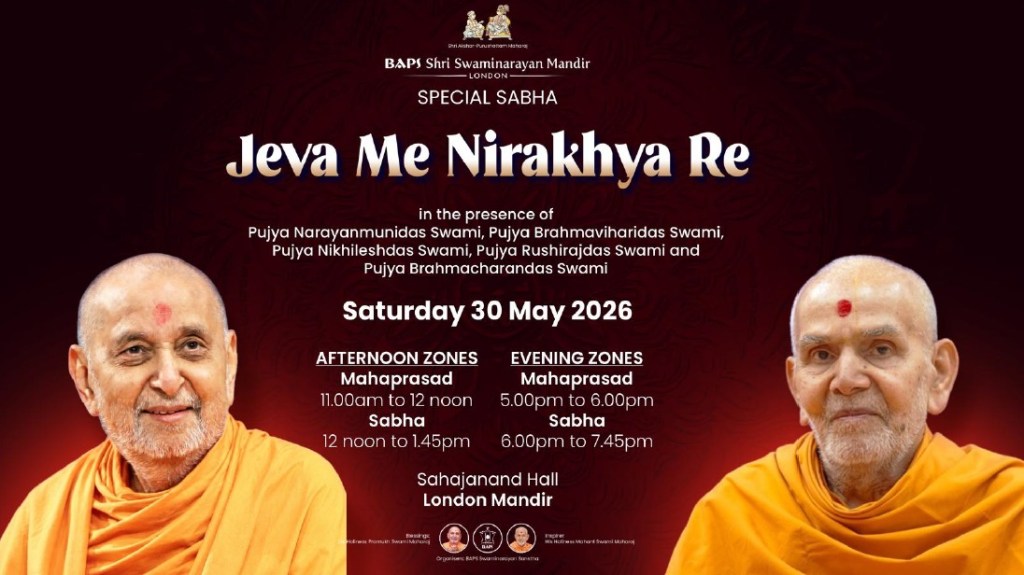
All the swāmis shared their stories while being with BAPS. They shared and cherished the moments with each other, and praised their Gurus for giving them an opportunity to serve the Hari Bhakto. They were in awe of London Hari Bhakto, especially because of the Islington history.
To everyone’s surprise and amazement, an announcement was made by Pujya Yogvivekdās Swāmi that, with the blessings of Param Pujya Mahant Swāmi Mahārāj, the Islington property had been re-acquired and the contracts had been exchanged a couple of days ago.
The entire hall was full of devotees, and their joy could be experienced from the decibel levels of their claps and chants of “Bhagwān Swāminārāyan ni jai”. The joy of the swāmis on the stage, and many other swāmis sitting in the sant-area, was visually greater when compared to the Hari Bhakto.
But above all, the happiest being in the room was on-screen: Param Pujya Mahant Swāmi Mahārāj. His videos with Pujya Yogvivekdās Swāmi were shared when this news was announced to Him a couple of days ago.
He was asked why this mattered so much to Him, and Pujya Mahant Swāmi Mahārāj’s response was: When you truly love someone, you love everything associated with them. We love Bapa, and He loved us. So we love everything in His association too.
He was asked, “Why do you love Pujya Yogiji Mahārāj so much?” He replied with one word, “Guru“, and calmly added further, “because He loved me/us so much“.
He was then asked, “What should we do next with the Islington property?” Pujya Mahant Swāmi Mahārāj said, “Have muddo haath ma aavi gayo“, meaning, we have now managed to overcome the main area of focus, and now it is in our control. So there is nothing to worry about. He then mentioned, “rang rehshe“, adding further, “have badhu thashe“.
Pujya Mahant Swāmi Mahārāj shows us the teaching of practising before preaching. His tremendous faith towards His Guru and Bhagwan is evident when he said, have badhu thashe.
As I sat in the hall and witnessed this moment, I found myself connecting with the story in a deeply personal way.
My Personal Connection
I was in the hall too, and I could connect with the entire incident, but in a different way. My dad bought our first home in Isanpur, Amdavad, India. Unfortunately, his business crashed, and we had to sell our property and move into a rental house.
I was 10 or 11 years old when this happened. When we were moving house, I was too small to understand what my dad and mom were going through. I asked my dad, “Why are we moving? I really love this house.” And my dad replied, “Don’t worry or think too much about it. Buy it again when you have enough money.”
To this day, I think of that house. We have moved out of Amdavad, so there is no point in buying it anymore, but the Islington mandir story helped reconcile my life in some way. I am glad that I was in the hall when this was announced.
Perhaps this is why the story of Islington mandir is not only about preserving a place, but about preserving love, faith and belonging.
A Story of Love and Guru-Bhakti
There were several stories shared by various Swāmis on how they grew up in the Islington mandir. It was a very small property, so everyone spent more time in common activities, which helped them gel more. In Pujya Brahmvihari Swāmi’s words, there was more freedom to sleep on the floor etc. in Islington, which is not possible now in the bigger BAPS mandirs, such as Neasden. Pujya Brahmvihāri Swāmi also narrated a story when he met Pujya Rushirājdās Swāmi in a bus for the first time while they were both travelling to the Islington mandir.
Islington is not just a building, a mandir or a property, it is a collective identity. The memories associated with the mandir are invaluable, and hence it is important to preserve that identity.
But more importantly, it is a story of love. Going back to the basics of spirituality, love is godliness because it connects one another. It is about the experiences and interactions, and we try to re-live and do things to please people we love.
Pujya Mahant Swāmi Mahārāj was asked why we struggled for more than 25 years and why all this happened.
He again responded with one word, “kasoti“, i.e. test.
He did not mention test of what. But I guess He implied there that we have been tested on several things: patience, hard work, perseverance, but most importantly, on how important our Guru’s words are for us. To me, that’s the muddo He probably referred to. There was nothing to prove, and it is not about proving, but it is a realisation of what matters the most.
The decibel level of the claps and the chants I experienced in the hall was living proof of what mattered to most of the Hari Bhakto. I was lucky to be present in person, and my gratitude to Pujya Tyāgratna Swāmi for inviting me to the sabhā.
On a personal front, I wish to see, someday, Islington mandir exactly as it was during the times of Param Pujya Yogiji Maharaj and Param Pujya Pramukh Swami Maharaj. I would like to feel their presence and live the experience of being with them too.
Jai Swaminarayan.
About the Author:
Bhavin Shukla has been working as an IT Consultant in the data space for more than 25 Years. As a Data and Analytics professional, he has worked extensively for years on complex IT Transformation Programmes within Healthcare, Finance, Insurance and Telco domains.
Bhavin is driven by a sincere desire to embrace a spiritual existence rooted in values, while genuinely striving to enhance societal culture by fostering a supportive community where we stand by each other.
Other BAPS Write-ups:
Bhagwān Bhaji Levā
A reflection on the life of Pujya Yogiji Maharaj, whose humility, devotion and joyful simplicity showed that true leadership lies in living what one teaches. His message, “Bhagwān Bhaji Levā”, reminds us to remain connected with God, stay humble in success, and find strength in surrender.

Swāminārāyan Darshan By Pujya Yog Vivek Swāmi
Swaminārāyan sampradaya and the Indian Schools of Philosophy.
BAPS Ground Zero: Meeting Pujya Brahmvihāri Swāmi at Neasden Temple, London, UK
The content discusses my spiritual encounter with Pujya Brahmvihāri Swāmi and the spiritual insights gained from the conversation. Pujya Swāmi emphasises living selflessly and the significance of life’s defining moments. The exchange is summarised as an embodiment of “Love,” linking to my understanding of love and my sincere request for the sādhu to bless me…
BAPS : A Modern Spiritual Organisation
Bochasanwasi Shri Akshar Purushottam Swaminarayan Sanstha (BAPS Swaminarayan Sanstha) is a spiritual institution that is quickly expanding and gaining popularity among the Indian Hindu community. What does the organisation do differently to reach out to the masses?
Based on my interactions with the BAPS satsangis (devotees), this is an attempt to share my understanding…


Leave a Reply